What the First Animal You Notice May Say About Your Personality!
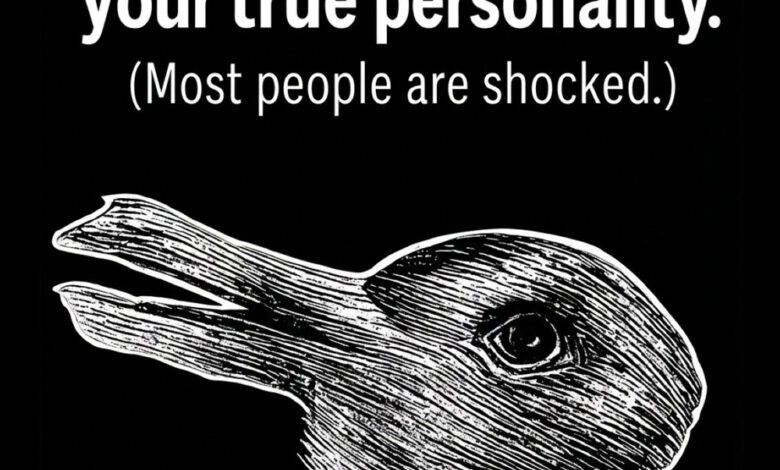
The human experience is often defined by the assumption that we all see the world through the same lens. We stand beside a friend, look at the same sunset or the same city street, and assume our internal maps of those moments are identical. Yet, the reality of human consciousness is far more fragmented and fascinating. Our brains are not passive recorders of light and shadow; they are active storytellers, constantly filtering raw data through the dense mesh of our past experiences, biological instincts, and current emotional states. This phenomenon is perhaps most elegantly captured in the world of optical illusions—specifically those “bi-stable” images where two distinct realities coexist in a single frame.
The way we interpret these visual puzzles reveals the intricate ways our minds prioritize information. When you look at a classic ambiguous drawing, your brain undergoes a high-speed negotiation. Within milliseconds, it must decide which lines form the subject and which form the background. This choice is rarely a product of conscious deliberation; it is a reflex, an instinctive lean toward a specific cognitive style. While these tests are not definitive psychiatric evaluations, they serve as a compelling mirror for our mental preferences, highlighting whether we gravitate toward the concrete or the conceptual, the logical or the lyrical.
Consider the legendary duck–rabbit illusion, a simple sketch that has intrigued psychologists and philosophers for over a century. The image is a masterpiece of economy, using a single set of lines to represent two vastly different creatures. The “beak” of the duck is simultaneously the “ears” of the rabbit. Neither interpretation is more valid than the other, yet for most people, one animal asserts its dominance almost immediately. This split-second prioritization is the brain’s way of revealing its primary operating system.
For those who find the duck first, the mind likely operates with a foundational preference for the practical and the grounded. The duck is a creature of clear lines and observant posture. Seeing it first often suggests a personality that prizes stability and logic. These individuals tend to be the anchors in a storm—people who remain calm under pressure because they process life through a lens of objectivity. They focus on what is tangible and immediate, preferring a well-defined map over a vague set of possibilities. This cognitive style is characterized by a “step-by-step” approach to problem-solving. It is an organized mind, one that finds comfort in clarity and is often adept at navigating the physical world with efficiency and grace.
In contrast, those whose eyes immediately lock onto the rabbit often lean toward a more intuitive and imaginative temperament. The rabbit, in this context, represents a shift in perspective—it requires the brain to reinterpret the “beak” as long, sensitive ears, a move that demands a degree of mental flexibility. If the rabbit was your first glimpse, you may be someone who naturally reads between the lines. This is the realm of the dreamer, the creative, and the emotionally perceptive. Such individuals are often highly sensitive to the mood and atmosphere of a room, picking up on subtle social cues that others might overlook. Their minds are restless in the best way, always exploring the “what ifs” and the symbolic meanings behind the mundane. While this can sometimes lead to a tendency to overthink, it also fuels a rich inner life and a deep capacity for empathy.
There is a third, perhaps even more intriguing category: those who see both animals almost instantly, or whose brains flip the image back and forth with rapid-fire frequency. This mental agility is a hallmark of high cognitive flexibility. It suggests an individual who is not easily locked into a single narrative. These are the natural mediators and polymaths of the world—people who can understand two opposing viewpoints simultaneously without losing their own sense of self. They are comfortable with ambiguity and complexity, recognizing that truth is rarely a monolith. This ability to switch perspectives at will is a profound asset in a world that is increasingly polarized, as it allows for a more nuanced and balanced understanding of reality.
Beyond the specific traits of the “duck person” or the “rabbit person,” these illusions point to a deeper truth about the nature of intelligence and personality. We are often taught to view logic and intuition as opposites, as if the brain must choose one and discard the other. In reality, the most effective minds are those that can bridge the gap. The duck provides the structure, the rabbit provides the vision. We need the observer’s logic to build the house, but we need the dreamer’s imagination to make it a home.
Optical illusions remind us that our first impression is merely one possible version of the truth. They teach us a valuable lesson in humility; if we can be “wrong” or “incomplete” about a simple drawing on a screen, we must surely be incomplete in our assessments of people, politics, and the complexities of life. This realization fosters a sense of curiosity. Instead of being frustrated when someone else sees the “beak” while we see “ears,” we can learn to ask, “How do you see that? What am I missing?”
The beauty of these mental exercises lies in their lack of finality. You are not a duck on Monday and a rabbit on Tuesday. You are the consciousness that is capable of hosting both. Your personality is not a fixed destination, but a fluid process that adapts to your environment and your needs. On a day when you are filing taxes or planning a project, you might find your “inner duck” leading the way with its sharp focus and grounded logic. On a day when you are painting, writing, or comforting a friend, your “inner rabbit” might take the reins, offering the intuition and creative spark necessary for those moments.
Ultimately, the most profound personality type is the one who realizes that perception is a choice. We have the power to train our brains to see more than just the first thing that catches our eye. By consciously looking for the rabbit when we only see the duck, we expand our mental horizons. We learn that the world is much bigger and more multi-faceted than our initial instincts suggest. This simple visual game is a reminder that while we may be shaped by our past and our biology, we are always free to shift our gaze, change our perspective, and discover a whole new animal hidden in the lines of our lives.