Alex Prettis Alleged Final Words Before Passing!
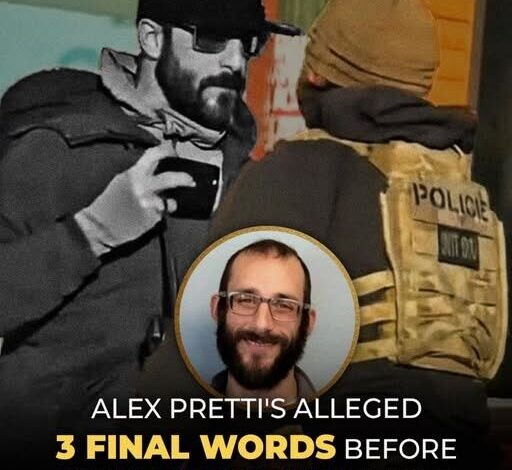
The streets of Minneapolis, often a theater for the nation’s most complex social tensions, recently became the site of a tragedy that has left a community fractured and a family in mourning. At the center of this storm is Alex Pretti, a man whose life was defined by the quiet rigors of medical service but whose death has become a loud, echoing cry for clarity and justice. As bystander videos saturate social media and official reports are dissected by legal experts, the narrative of what happened in those final, chaotic moments has become a battleground of perspective. Yet, beneath the layers of political debate and forensic analysis lies the story of a 37-year-old man who, by all accounts from those who knew him, lived a life dedicated to the preservation of others.
Alex Pretti was not a man who sought the spotlight. As an intensive care unit nurse at the Minneapolis VA Hospital, his daily reality was one of high stakes, whispered reassurances, and the steady beep of heart monitors. To the veterans he treated, he was a calm presence in their most vulnerable hours; to his colleagues, he was the reliable anchor during a grueling double shift. His parents describe a son who viewed compassion not as a series of grand, performative gestures, but as a consistent, quiet duty. He believed in the inherent dignity of the person in front of him, a philosophy that guided his hand whether he was adjusting an IV line or navigating the complexities of his community.
The confrontation that claimed his life began with a volatility that is now all too familiar. Federal immigration agents were conducting an operation on a Minneapolis street—a situation that quickly drew a crowd and escalated into a fever pitch of shouting and physical maneuvering. According to witness accounts and family members who have reviewed the available footage, Pretti’s involvement began not with aggression, but with an instinctual move to protect. Witnesses claim that Pretti stepped forward when he saw a woman pushed during the scuffle, attempting to intervene as a shield or to check on her well-being. This action, his family maintains, was entirely consistent with the man they knew—a nurse whose first response to distress was always to move toward it, rather than away.
However, the official narrative provided by federal authorities paints a starkly different picture. Investigators have asserted that Pretti was armed and posed an immediate, lethal threat to the officers on the scene. This claim has become the eye of the needle through which all evidence must now pass. Multiple bystander videos, captured from varying angles, show a frantic sequence of events. In several clips, Pretti is seen holding a dark object that his supporters identify as a mobile phone. These videos do not clearly depict him raising or pointing a firearm at the agents. In one of the most harrowing segments of footage, Pretti appears to be on or near his knees—a posture of relative surrender—when the first volley of gunfire erupts.
The dissonance between the “service-driven nurse” and the “armed threat” has sparked a firestorm of public scrutiny. Federal investigators emphasize that video footage is often deceptive, capturing only a fraction of the sensory information available to officers in a split-second, life-or-death encounter. They suggest that the totality of the circumstances justified the use of force. Conversely, legal advocates and civil rights groups point to the footage as evidence of an unnecessary escalation, arguing that a man on his knees holding a phone should not end up as a casualty of federal enforcement.
In the wake of the shooting, a neuroscientist’s analysis was introduced into the public discourse to explain a specific, controversial movement Pretti made just before the fatal shots: reaching toward his back pocket. While authorities might interpret such a gesture as reaching for a weapon, experts in human behavior and high-stress physiology suggest it could be a reflexive “startle response” or an attempt to retrieve a phone or ID to de-escalate the situation through documentation. This scientific perspective adds a layer of complexity to the tragedy, suggesting that in the heat of a confrontation, a benign survival instinct can be tragically misinterpreted as a hostile act.
Adding further complication to the public’s perception are recently released videos from an encounter eleven days prior to the shooting. In that footage, Pretti is seen in a separate, heated confrontation with federal agents, where he allegedly displayed a more defiant attitude, including kicking a vehicle’s taillight. Critics of Pretti point to this as evidence of a pattern of volatility and anti-authority sentiment. His supporters, however, see it as the frustration of a man who was deeply troubled by the aggressive tactics he witnessed in his neighborhood. They argue that a previous moment of anger should not serve as a justification for a subsequent fatal shooting, nor should it erase a decade of documented service in the medical field.
As the investigation moves into its more formal stages, Minneapolis finds itself once again at a crossroads of public trust. For the nursing students who trained under Pretti, the news was a devastating blow. They remember a teacher who was patient, even when the ICU was at its most chaotic, and who taught them that the most important tool a nurse has is their ability to stay grounded when everyone else is panicking. To them, the idea of Pretti as a violent aggressor is irreconcilable with the person who spent his nights saving lives.
The final words of Alex Pretti, or the lack thereof in the roar of the gunfire, remain a haunting mystery. Whether he was trying to plead for calm or simply trying to survive the next ten seconds, the result remains a permanent void in the lives of those he served. His death has become a symbol of the broader, simmering tensions regarding federal presence in local communities and the thin, often blurred line between enforcement and escalation.
Ultimately, the story of Alex Pretti is a tragedy of conflicting realities. It is the story of a man whose life was spent in the pursuit of healing, ended by the very forces meant to maintain safety. As the city waits for the official findings of the Department of Justice and the local coroner’s office, the focus for Pretti’s family remains on the legacy of his character. They hope that the final image of Alex will not be the grainy, chaotic footage of a street-side shooting, but the memory of a man who believed that every person deserved a hand to hold in the dark. In a world increasingly divided by narrative, they are searching for a singular, undeniable truth: a clarity that honors the life he lived as much as it accounts for the way it ended.