I Was Fired In A Crane 200 Feet Up «Pack Your Trash, I Dropped A 20-Ton Container Trapped Him Inside
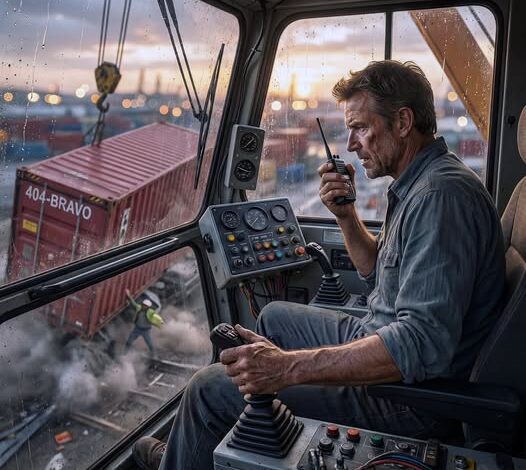
The radio crackled, and Derek’s voice cut through the wind like a jagged knife. He had fired me for refusing to bypass a safety protocol that would have endangered every man on the pier. He thought he held the absolute power of the purse because he signed the checks, but he was fundamentally mistaken. I was currently perched 200 feet in the air, piloting a massive Liebherr crane and holding a 20-ton shipping container in my mechanical grasp. I decided right then to show him exactly what gravity—and a union operator pushed to his breaking point—could achieve.
There is a specific, heavy kind of silence you only find at 200 feet. It’s not a true absence of sound, but rather a hum of isolation. The wind howls constantly, battering the tempered glass of the cab like an angry spirit. The steel structure of the gantry crane groans and creaks, a metallic symphony of stress that only a veteran operator learns to interpret. Compared to the industrial chaos of the Port of New Jersey below—the screaming semi-truck engines, the shouting stevedores, and the clatter of metal on pavement—up here felt like a sanctuary. I adjusted the joysticks, feeling the machine respond to the slightest twitch of my fingers. My name is Frank Mercer, but on the docks, they just call me Iron.
I’ve been sitting in this chair for 32 years. I know the rhythm of the port better than the layout of my own home. I know exactly how much sway a 20-ton container creates in a 15-knot crosswind, and I know when a foreman is trying to get someone killed.
“Iron, you copy?” The voice on the radio broke my concentration. It was the nasal, impatient whine of Derek Walker. Derek was twenty-eight years old, wore a hard hat that looked like it had just come out of the plastic wrapper, and drove a BMW that cost more than my first mortgage. He was a “nepotism hire,” installed as the site foreman three weeks ago to “optimize efficiency,” which usually meant cutting corners until someone got crushed.
“I copy, Walker,” I said, keeping my voice flat. “I’m in the middle of a lift. Container 404-Bravo. Heavy load.”
“You’re moving too slow, Frank,” Derek snapped. “The trucks are backed up to the gate. Bypass the load sway dampener. Just swing it and drop it. We need speed today, not precision.”
I tightened my grip on the control. The dampener prevented the massive steel box from turning into a wrecking ball if the wind picked up. Bypassing it was a violation of OSHA regulations, company policy, and common sense. “Negative,” I replied. “Wind is gusting at 18 knots. If I disable the dampener and we catch a gust, I could take out the truck cab. I’m not killing a driver to save you three minutes.”
“I didn’t ask for your opinion, Mercer! Override the safety and speed it up. That’s a direct order.”
I looked down. From this height, Derek was a tiny figure in a bright orange vest, a tourist in a land of giants trying to command forces he didn’t understand. I lowered the container with agonizing, deliberate precision until it locked onto the truck chassis with a soft thud. I knew I had pushed him, and men like Derek hate being told “no” by men with grease under their fingernails.
The radio crackled again, but this time, the whine was replaced by cold, malicious intent. “Mercer, bring the boom to a rest position. You’re done. You’re fired. Insubordination and refusal to follow a direct order. I’m marking it down as a safety violation on your record—negligence.”
The audacity was breathtaking. For refusing to be negligent, I was being branded with the one word that would end my career. “I already called the union hall,” Derek lied. I could hear the smirk. “Told them you were operating under the influence. Erratic behavior. Pack your trash and climb down. Security is waiting to escort you off the property.”
My blood ran cold. An accusation of drinking on the job would strip my license and my pension. He was destroying my life to cover his ego. I looked at the control panel, then at the exit gate—the single lane in and out of this section of the port. It was a narrow choke point flanked by concrete barriers and deep water.
“You want me to stop working, Derek?” I asked, my voice dangerously calm.
“I want you out of my sight,” he spat.
“Alright,” I said. “But first, I have one last move to make.”
I grabbed the joystick and swung the boom hard to the left, away from the ship and toward the stack of high-priority imports. I lowered the spreader onto a 40-foot container painted a dull, rusted red—404-Bravo. Derek had been obsessively checking on this specific box all week. The twist locks engaged with a metallic clank. I lifted it 200 feet into the air.
“Mercer, put that down! That’s not on the manifest!” Derek was screaming now.
“I don’t work for you anymore, Derek. I’m just cleaning up.”
I slid the crane toward the main gate and positioned the 20-ton container directly over the narrowest point of the exit road. “You’ve got nothing left to threaten me with,” I whispered, and flipped the release toggle.
The massive red box plummeted. It hit the asphalt with a sound like a bomb going off, embedding itself into the tarmac and turning the exit gate into an impenetrable steel wall. The force was so violent that the seams of the container split open. I leaned forward, squinting through the glass. It wasn’t scrap metal inside. I saw the glint of polished copper spools and the black casings of high-end server racks—hundreds of thousands of dollars in high-value electronics and raw materials, being shipped out as “garbage.”
“Oops,” I said into the radio. “Slipped.”
I pulled the ignition key from the slot, ending the engine’s deep hum. I looked at the silver fob, then tossed it out the side window. It caught the light for a second before disappearing into the dark, churning water of the harbor 200 feet below. Without that digital key, the crane was now a $2 million paperweight.
“Come and get me,” I said to the dead air.
I climbed down the tower ladder, my bad knees aching with every step. By the time I hit the ground, Derek was sprinting toward me, his face a mask of purple rage. “I’ll have you buried under the jail!” he screeched.
“Can’t move the crane, Walker. Keys are in the ocean,” I said, walking toward my truck.
Derek went pale as the Port Authority Police and Commercial Enforcement teams arrived. Because the road was damaged, they were required to inspect the scene—and the contents of the split container. I sat in my Ford F-150 and called an old friend, August Clark, a private investigator with a knack for digital forensics.
“Iron,” August answered. “I see the news. Blockage at Gate 4?”
“Derek Walker is smuggling high-value copper and tech as scrap,” I told him. “I need you to flip the script before he frames me.”
Minutes later, Derek approached my truck, offering a $10,000 bribe and my job back if I “found” a spare key and moved the crane before the inspectors opened the box. “No deal,” I said, rolling up the window when he threatened my wife’s health insurance.
August texted me a file. “I hacked the crane’s internal telemetry, Frank. It records audio and video for insurance. I’ve got the whole thing.”
I opened the video on my phone. There was the footage: Derek’s voice clearly ordering me to bypass safety protocols and then firing me for my refusal. I sat back as the federal agents approached the red container. I had lost my job that morning, but as the inspectors began pulling apart Derek’s “scrap” to reveal the stolen fortune inside, I knew I was the only one who would be walking away clean.