The Biker Who Hit My Son Never Missed a Day at the Hospital, Until the Morning My Boy Finally Woke Up
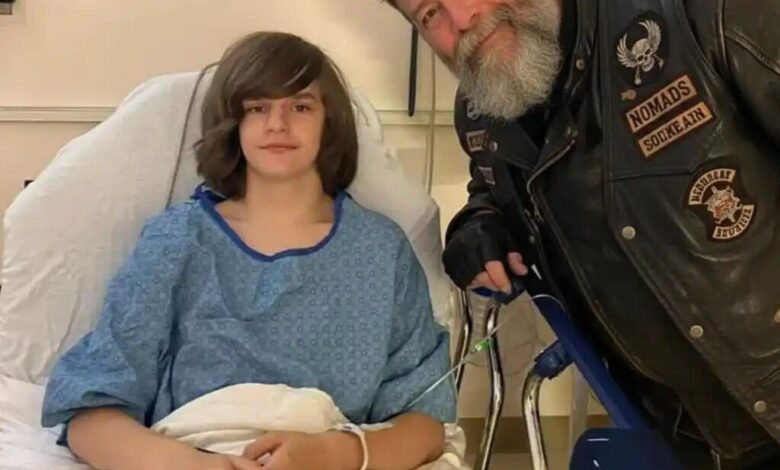
For forty-seven days, the world was a silent, sterile vacuum. My twelve-year-old son, Jake, lay motionless in a hospital bed, a victim of a physics equation that had gone horribly wrong. It had been forty-seven days since the screech of tires and the concussive thud of impact shattered our family’s peace. The police reports were clinical and absolving: Jake had chased a runaway basketball into the street; the rider had been under the speed limit; the rider had stayed, performed CPR, and saved my son’s life in those first golden minutes.
Logic, however, is a poor bandage for a bleeding heart. To me, the man on the motorcycle wasn’t a savior; he was the person who had stolen my son’s laughter and replaced it with the rhythmic, mechanical hum of a ventilator.
His name was Marcus. I didn’t learn it until the third day, when I walked into the ICU and found a stranger sitting by Jake’s bed. He was a mountain of a man—tall, clad in a weathered leather vest, with a salt-and-pepper beard that hid a jaw set in grim determination. He was reading aloud from a worn copy of Harry Potter. The sight of him in that sacred, tragic space ignited a primal fury in me. I screamed, I threatened, and I nearly threw a punch before security led him away.
But the next morning, Marcus was back. And the morning after that.
My wife, Sarah, possessed a grace I couldn’t yet find. She pointed out that he hadn’t fled the scene, that he had been the one to keep Jake’s heart beating until the paramedics arrived. “Maybe he needs this as much as Jake does,” she whispered. I didn’t want to hear it, but as the weeks bled into one another, Marcus became a permanent fixture of our vigil.
He sat in the same plastic chair every morning. Sometimes he read from Percy Jackson or The Hobbit; other times, he simply talked to Jake as if they were old friends discussing the merits of baseball or the mechanics of an engine. Eventually, the silence between Marcus and me began to thaw. One afternoon, he told me about his son, Danny. Danny had died two decades earlier in a car accident. He was around Jake’s age. Marcus hadn’t been there when it happened, and he had been carrying the weight of that absence like a sack of stones ever since. “I couldn’t be there for my boy,” Marcus said, his voice cracking like dry timber. “But I can be here for yours.”
In that moment, the villain in my narrative evaporated. In his place was a grieving father attempting to bargain with the universe for a second chance at a different ending.
By the third week, the ICU room felt less like a tomb and more like a bridge. On the twenty-third day, a low rumble began to vibrate through the hospital floor. Outside, fifteen members of Marcus’s motorcycle club, the Nomads, had gathered in the parking lot. In a coordinated display of raw power and solidarity, they revved their engines in unison, a mechanical thunder intended to reach into the depths of Jake’s coma. Sarah cried as she watched them from the window. “If he can hear anything,” she said, “he’ll hear that.” That night, for the first time, Jake’s heart rate spiked on the monitor.
But the progress was agonizingly slow. By day thirty, the doctors began to use words that sounded like death sentences: permanent neurological damage, long-term care, vegetative state. I collapsed in the hallway, the air leaving my lungs. Marcus was there. He didn’t offer platitudes or false hope; he simply sat on the floor beside me in silence. After a long time, he spoke: “You can’t give up. Not yet.”
His faith was irrational, yet it became the only thing I had to hold onto. On day forty-five, he brought a model motorcycle kit into the room. “For when he wakes up,” Marcus insisted. “We’re going to build this together.”
On the forty-seventh day, the miracle happened. It started with a twitch in Jake’s left hand. Marcus saw it first. We froze, staring at the bed as if watching a seed break through frozen earth. Then, Jake’s eyelids fluttered. I grabbed his hand, my heart hammering against my ribs. “Jake! Buddy, it’s Dad. Can you hear me?”
His eyes opened—clouded at first, then focusing. His gaze drifted past me and landed directly on Marcus.
“You…” Jake’s voice was a raspy, fragile thing. “You’re the man who saved me.”
Marcus looked stricken, the tears already welling in his eyes. “Son, I… I’m the one who hit you.”
Jake shook his head weakly, a ghost of a smile touching his lips. “You stopped. You pulled me back from the dark. You held me and told me not to close my eyes. I heard you every day.”
The room became a place of profound, weeping catharsis. Marcus—this hardened, tattooed biker—sobbed openly at the bedside of the boy he thought he had destroyed. Jake remembered everything: the flash of the bike, the terror of the impact, and the steady, gravelly voice that had read him stories about wizards and hobbits while he was lost in the fog of his coma. He hadn’t wanted Marcus to be sad anymore.
Jake’s recovery was a long, arduous climb, but Marcus never missed a step of it. He was there for the first time Jake sat up, the first time he took a step in physical therapy, and the day he was finally discharged. On that final day, Marcus presented Jake with a small leather vest. Stitched on the back were the words HONORARY NOMAD. “You fought your way back,” Marcus told him. “That makes you family.”
Two years have passed since that day. Jake is fourteen now, a healthy teenager who spends his Sunday afternoons in our garage. If you were to look inside, you’d see a boy and a man with grease-stained hands, their heads bent over a shared project. They finished the model long ago; now, they’re rebuilding a real vintage motorcycle.
Marcus told me once that forgiveness isn’t a one-time act—it’s something you have to live out every day. Watching him teach Jake how to gap a spark plug, I finally understand. Marcus didn’t just save my son’s life on that asphalt two years ago; he saved our entire family from the bitterness of tragedy. He showed us that some angels don’t have wings or halos. Sometimes, they wear leather jackets, ride Harleys, and refuse to leave your side until the light comes back.