My Husband Believed I Did Nothing All Day with Our Baby, Until I Left Him Alone for a Week!
Life with my husband, Victor, had settled into a comfortable, predictable rhythm until the moment I discovered I was pregnant. I made the conscious decision to quit my job, eager to immerse myself fully in the role of mother and wife. Victor supported the choice, framing it as an investment in our future daughter’s wellbeing. During those nine months, my energy was boundless. My “nesting” instinct kicked in early, morphing me into a domestic whirlwind. I cooked elaborate meals, polished the floors until they shone, and ensured every cushion was plumped and every surface was spotless.
“Our house has never looked this good, Jamie,” Victor would tell me, kissing my forehead as he walked into our polished living room. “Thank you for keeping everything together for us.” His appreciation, rooted in the tangible results of my labor, warmed me deeply. I maintained that pristine routine right up until the last weeks, convinced I had mastered the art of domesticity.
The day our daughter, Lily, arrived at 39 weeks, my universe was fundamentally and irrevocably rearranged. The moment the tiny, perfect human was placed in my arms, every previous definition of love and responsibility was obliterated. My former routines, the spotless surfaces, the planned menus—they ceased to exist. All that remained was Lily’s fierce, demanding need. She required me for everything: every feeding, every whimper, every transition from sleep to alertness. She was, quite literally, my entire universe, and she was relentless.
To Victor, however, my workload appeared to have shrunk. He saw only the visible evidence of chaos: the laundry baskets overflowing, the meals devolving into reheated leftovers, and the perpetual layer of clutter that now coated our former showpiece of a home.
“Why has the house gotten so messy?” he asked one Tuesday evening, frowning as he retrieved the third night of chili from the fridge. “And we’ve been eating the same food three days in a row. You’re home all day, what gives?”
A raw, exhausting anger flared in my chest. “I don’t have time to cook something new every day, Vic,” I explained, gently bouncing Lily, who was beginning to fuss. “She has colic. She cluster feeds for hours. If I put her in the crib, she screams. I have barely managed to shower this week, let alone bake bread or mop the floors.”
Victor sighed, his entitlement making my blood run cold. “She can stay in the crib for a while. You could strap her in the carrier and do things around the house. It won’t take that long, Jamie. Stop hiding behind the baby and admit you’re being lazy.”
His words were an electrical shock of pain and indignation. The accusation of “lazy” after weeks of surviving on four fragmented hours of sleep a night was the final, cracking point. “Why don’t you try it, then?” I yelled, my voice cracking with exhaustion. “You clock out and come home to rest. I clock in at midnight and don’t clock out until the next midnight. You have no idea what it is like to breastfeed every two hours, to pace the floor with a screaming child from dusk till dawn, to be so trapped by necessity that your own name feels foreign. I literally have no time to do anything else!”
“I work all day to pay for this house and this life,” he shot back, retreating behind the firewall of his financial contribution. “I come home to chaos and complaints. Of course I’m frustrated.”
I turned away, tears streaming silently down my face as I carried Lily into the bedroom. His financial support, while vital, felt like a transactional counterpoint to my emotional and physical collapse. He was barely present in the evenings, offering a perfunctory diaper change at best, and remained completely oblivious to the isolation, the relentless, grinding fatigue, and the sheer volume of “invisible labor” that filled my twenty-four-hour shift.
In that moment, I understood that words were useless. No amount of explanation could bridge the cavern between his perception of my days and the punishing reality. If Victor was ever going to gain true empathy, he would have to live it.
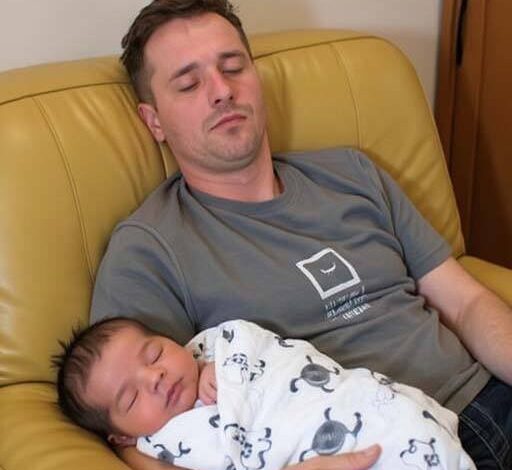
The opportunity presented itself on a quiet Saturday afternoon. Lily had finally fallen asleep draped across his chest—a rare moment of tranquility. I kissed her forehead, then slipped quietly downstairs. I left a small note on the kitchen counter, brief and chillingly simple: “I’m going on vacation and will be back in a week. Lily’s milk is in the fridge.”
I had secretly packed my overnight bag the day before. I switched off my phone, took the car keys, and drove straight to the coast. For the first time in months, I reclaimed myself: I slept for eight consecutive hours, walked barefoot on the sand until my feet were numb, read novels that had nothing to do with motherhood, and ate entire meals while they were still hot. The guilt I expected never arrived; only a deep, desperate sense of recovery.
When Victor awoke and found the note, the initial shock gave way to a furious panic. He had to handle Lily alone. There were no sitters, and hiring a professional nanny wasn’t an option.
The first night was an adrenaline-fueled disaster of misplaced bottles and fumbled changes. By the second night, his calls began, frantic and filled with bewildered desperation. “I get it! Just come home already!” he pleaded into the void, having forgotten I had turned off my phone.
Miles away, I was monitoring the situation. Before leaving, I had linked the baby monitor app to my tablet. What I witnessed confirmed everything I had known. Victor was spectacularly, ruinously drowning. The sink was a towering monument to unwashed dishes. Takeout bags piled up. Lily was fed and clean, but Victor wore the thousand-yard stare of acute sleep deprivation. I watched him pace the same floor I had paced, bouncing Lily in the same desperate rhythm, his anger replaced by crippling exhaustion.
By Wednesday, he broke down completely. Through the app, I watched him call his mother, his voice cracking and raw. “Mom, please help me. Jamie left for a vacation and just left me a note. I haven’t slept in days. I can’t do this.”
I had to suppress a bitter laugh when I heard my mother-in-law’s shrill, judgmental response. “How irresponsible! What kind of woman abandons her husband and child like this? Raising children and keeping house is a wife’s job. If she can’t handle it, she shouldn’t have gotten married!” I remembered clearly that this was the woman who had employed two nannies when Victor was a baby—she had never personally known the terror of a four a.m. cluster feed. Her hypocrisy was astounding.
Victor toughed out the remaining days, showing up at work looking like a shipwrecked sailor, his tie crooked and his face gray. He called in sick one day just to survive. The experience was transformative.
When I finally returned one Saturday afternoon, I braced for the explosion. Instead, he met me at the door and embraced me in a hug so tight I could feel the hammering desperation of his exhausted heart.
“I am so sorry, Jamie,” he whispered, his voice low and raw with earned humility. “I didn’t understand. I truly didn’t know what I thought. I was profoundly wrong. You go through so much every day, and I still demanded more. Please forgive me.”
His eyes were bloodshot and tired, but for the first time since Lily was born, they were clear. He had seen. He had lived the invisible labor.
“I promise I’ll be a better partner,” he vowed. “More present. More helpful. You and Lily deserve that, and so much more.”
I wanted to believe him, and in the clarity of his exhaustion, I knew his apology was genuine. Yet, the sting of my mother-in-law’s judgment lingered, echoing the harmful societal narrative that motherhood is a solo burden. That week confirmed my truth: Parenting isn’t a solo act defined by gender; it’s a partnership defined by shared responsibilities, late nights, early mornings, and a commitment to carrying the weight equally. Victor finally understood that. And I still wonder how many women are silently breaking under the pressure, dismissed as “lazy” when the truth is that there is nothing, absolutely nothing, lazy about the sheer, continuous, demanding labor of motherhood.