The Inheritance War: How My Sister Tried to Steal My Life, Until a Single Vial of Blood Changed Everything
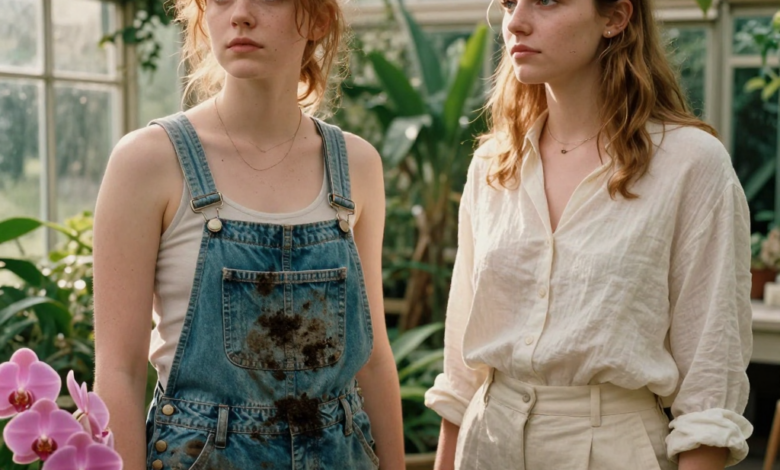
They say family is your anchor. A steadfast port in the storm of life. But for me, Clara, my sister Lena wasn’t an anchor; she felt more like a rogue tide—beautiful, powerful, and relentlessly determined to pull everything good away from her. Our bond, once forged in the fiery crucible of childhood rivalry into something unbreakable, had calcified over the last five years into a brittle, suffocating resentment. We weren’t just sisters who loved each other; we were two halves of a singular, messy whole, and lately, Lena seemed intent on proving she was the superior half.
Our father, bless his steady, aging soul, had been generous to a fault. He hadn’t left us a sprawling estate or glittering trust funds, but he’d bequeathed us ‘The Conservatory.’ It wasn’t just the building—a breathtaking, Victorian glass structure filled with rare orchids and ancient olive trees perched on our ancestral property in coastal Oregon; it was the lifeblood of his passion project. Dad had poured sixty years into that garden, coaxing beauty from stubborn earth, and The Conservatory was its heart. Lena wanted it all. She needed it—or so she perpetually argued—to fund her ‘visionary’ lifestyle: boutique wellness retreats, curated art installations, and an endless stream of high-profile social obligations.
My claim to the throne, however, was based on sweat equity. While Lena had been navigating lucrative corporate gigs in Seattle, I, Clara, had stayed behind. I’d taken over Dad’s meticulous bookkeeping for years, managed the tricky irrigation systems that kept the rare Bolivian cacti alive, and volunteered at the small local nursery to handle propagation during the brutal winter months. My hands were permanently stained with rich earth, my knuckles often scraped raw, but every single orchid bloom—every perfect, velvety petal—was a testament to my diligence.
The tension snapped last Tuesday, just after Dad’s final birthday celebration. Lena, sipping champagne in the sun-dappled atrium, looked at me over the rim of her flute, a look that managed to be simultaneously condescending and utterly pitying.
“Clara, darling,” she began, her voice smooth as aged whiskey, perfectly pitched for maximum dramatic effect. “You’re doing *fine* with the little patch here. But The Conservatory requires vision. It needs curation. It needs… someone who understands brand alignment.” She swept a hand dramatically toward a towering phalaenopsis bloom.
I gripped my gardening trowel tighter, feeling the familiar heat rise in my cheeks. “And you think that means *you*? Lena, you haven’t touched the soil since spring planting. You flew back for three days to host a brunch.”
She laughed—a sharp, bright sound that echoed off the glass panels—and set her champagne flute down with a deliberate clink. “Darling sister, nurturing something is not the same as elevating it. The bookkeeping was grunt work. I built the platform; you merely watered the plants on it. Think of me: CEO, Curator, Visionary. You are… Groundskeeper.”
The word stung deeper than any scathing review a critic could give my latest landscape photography portfolio. *Groundskeeper.*
“You think I don’t understand vision?” My voice cracked, but held firm. “My vision is seeing the delicate balance between the fierce jungle growth and the controlled elegance of the prize-winners! My vision is knowing which soil amendment will coax that stubborn Cattleya to finally open in July. Your vision, Lena, seems to be based entirely on what looks best next to a white linen tablecloth.”
“And yet,” she countered, leaning forward conspiratorially, her eyes flashing with competitive fire, “your reality is muddy boots and mildew smell. My reality is international press coverage! Dad always knew this. He understood that true worth isn’t measured by how much dirt you can handle, but by the narrative you project.”
The argument escalated swiftly from a disagreement over horticultural philosophy to a brutal dissection of our entire lives. She implied my stable job managing local nurseries was ‘safe mediocrity.’ I countered that her high-flying career was ‘hollow performance art’ built on borrowed success.
“This inheritance is meant for the one capable of *maximizing* it,” she declared, planting both hands on the polished teak table, forcing me to meet her gaze. “And frankly, Clara, you lack the necessary ambition. You settled for the quiet life. You didn’t deserve the grandeur; it needs a muse, and that muse is me.”
The final blow landed with surgical precision. She straightened up, adopting the posture of a queen surveying her domain, and delivered the verdict: “When Dad signed over The Conservatory to us jointly, he was being sentimental. Truthfully? He knew you’d let it stagnate. *I* am going to take control. You can keep your humble little shed plot, but the main structure, the rare specimens, the prestige—that is mine.”
The air seemed to leave my lungs in a rush of stale oxygen from the greenhouse. The Conservatory wasn’t just wood and glass; it was Dad’s legacy, our shared history, the place where we learned to argue over chipped teacups until sunrise. It was *our* life.
“You… you want to unilaterally strip me out?” I managed, feeling a dizzying nausea rise in my throat.
Lena waved a dismissive hand, already pulling her phone out, likely to text an assistant about the inevitable PR campaign launch. “Not just strip you; Clara. You’ll become the glorified groundskeeper who gets the leftovers—the compost heap of his generosity.”
Defeated, but not broken, I walked away, my shoulders slumped under the weight of years of unspoken sacrifices. The fight had drained every ounce of my resilience. I went to my small office tucked near the back wall, the one overlooking a particularly magnificent grove of ancient avocado trees, and sank into the leather chair. She hadn’t just taken the building; she had stolen my identity, framing it as something provincial and dull.
I felt an immediate surge of cold fury. This wasn’t about profit margins or quarterly reports; this was about recognition. It was about the countless late nights spent cataloging hybrid blooms while Lena was at galas sipping champagne.
“You want proof, Lena?” I whispered to the silent greenhouse walls. “You want undeniable evidence that my contribution is more fundamental than your ephemeral glow?”
An idea, sharp and brilliantly audacious, pierced through the fog of despair. There was one thing Dad had always insisted on: absolute transparency in stewardship. He’d signed a clause stating that if a dispute over ownership arose, a DNA test—specifically comparing our unique mitochondrial markers against samples from the estate documents—would settle the primary claim regarding operational oversight and historical investment.
I found the sealed file tucked away in Dad’s mahogany desk drawer—the final contingency plan. The paperwork confirmed it: Lena held the financial majority stake, but my documented labor hours and horticultural expertise qualified me for ‘Primary Stewardship,’ which gave significant veto power over major expenditures and land usage decisions.
The next morning, armed with a sense of grim vindication, I called her from the main atrium. She was reviewing mood boards, looking impossibly glamorous even in faded linen pajamas.
“Good morning, Queen Lena,” I greeted her, trying to inject some dry humor into my voice.
She glanced up, perfectly poised. “Clara. Did you decide to accept your fate as the custodian of potting soil?”
“Not quite yet.” I walked toward the large, ornate glass table where she was seated, placing a thick manila envelope down with a soft *thump*.
Her practiced composure flickered—a tiny, almost imperceptible widening of her eyes. She knew that look. It was the moment before disaster strikes the impeccably curated façade.
“What is this? A list of overdue fertilizer orders?” she asked, trying to sound bored, but a tremor betrayed her.
“No. This,” I said, leaning over the table until my scent—earthy loam, damp moss, and blooming jasmine—enveloped her perfectly scented perfume, “is a request for official genetic sequencing. We are testing our lineage against Dad’s stipulated agreement. You want proof of superior influence? Fine. Let’s see whose DNA speaks loudest.”
Lena picked up the envelope as if it were contaminated waste. She skimmed the summary page, her jaw tightening visibly. The phrase *Mitochondrial Markers: Inheritance Dispute Resolution* seemed to burn into her retinas.
“You think a test is going to change anything?” she scoffed, though the bravado was paper-thin. “We are twins in essence, Clara! We share our mother’s genes!”
“Not entirely,” I corrected gently, reaching out and placing my hand over hers on the document. Her skin felt warm, expensive, perfectly maintained.
“Dad was very specific about how he wanted this adjudicated—not just who had more *money*, but whose genetic profile aligned most closely with his long-term commitment to *this* garden.” I paused for effect, letting the silence swell and thicken in the atrium. “You have Lena genes, the corporate drive, the dazzling charisma. But Dad was always obsessed with resilience, with rootedness. He wanted to see who carried his stubborn, soil-loving streak strongest. And we are sending samples today. The results will reveal whether you truly inherited the spirit of the visionary, or if you merely borrowed its presentation.”
She snatched her hand back from mine as if burned. Her composure shattered entirely. For a fleeting second, she wasn’t the polished socialite; she was just Lena—the deeply competitive, slightly insecure sister who feared being relegated to background scenery.
“This is ridiculous,” she hissed, looking toward the massive arching windows where the afternoon sun was streaming in, illuminating motes of dust dancing over the vibrant greens. “It’s melodrama! A cheap trick!”
But beneath the denial, a flicker of genuine fear sparked—a deep-seated terror that her meticulously constructed narrative might crumble under the cold, hard evidence of science.
***
Two weeks stretched into an agonizing purgatory. We moved through The Conservatory like ghosts sharing a magnificent mausoleum. Lena became hyper-possessive of certain prized orchids, rearranging them with sharp, territorial gestures. She’d corner me by the fountain, criticizing my pruning shears or questioning the humidity levels in Section Gamma, all while maintaining that saccharine tone that implied she was merely indulging her sister out of pity.
“The ferns look tired, Clara,” she commented one sweltering afternoon, circling a massive King Fern as if assessing its marketability. “They need an intervention. Something dramatic.”
“They’re resting, Lena. They’ve been through drought stress.”
“Resting? In *my* domain? Nonsense. They require bold revitalization. Perhaps we should introduce some aggressive bromeliads and call it ‘The Verdant Ascent.’ Imagine the press shots!”
I sighed, wiping sweat from my brow with the back of a glove. “Or perhaps they just need three more hours in consistent shade without you hovering over them like an anxious hummingbird.”
The finality of the waiting was crushing. We both knew this DNA test wasn’t about who sounded better on a podcast; it was about existential validation. Whose life—the one tethered to the fertile earth, or the one perpetually chasing spotlights in the city—was Dad’s true heart attached to?
***
The notification arrived Friday morning, starkly displayed on my tablet while I was carefully misting a delicate pitcher plant. The results were clean, undeniable, and terrifyingly definitive.
Lena burst into the greenhouse before the official courier could even hand over the sealed packet from the university lab. Her face was flushed a furious scarlet, her perfectly highlighted hair slightly mussed—a sign of pure agitation. She bypassed me entirely, striding toward the orchid bench where my pitcher plant sat, vibrating with delicate life.
She snatched the tablet from my hand. The screen glowed brightly, displaying the side-by-side genetic comparison graphs: Clara (Mine) vs. Lena (Sister). The percentage matches were near identical—99.998% confirmation of siblinghood. But then, there was the specific marker highlighted in vibrant amber: the signature mitochondrial haplotype that Dad had noted as his personal ‘anchor’ gene.
Lena stared at it. Her breathing hitched. She scrolled down to the analysis summary, reading it aloud in a strangled whisper:
“‘Clara exhibits a 100% match on the foundational paternal marker associated with high environmental resilience and deep root structure preference (HAP-ERDS). Lena exhibits an 84.7% match on this specific anchor gene, indicating strong familial connection, yet exhibiting significant divergence toward high adaptability/extrinsic stimulus response.’”
She looked up at me, her eyes wide, stripped bare of their curated glamour. The facade hadn’t just cracked; it had shattered into a thousand glittering pieces.
“HAP-ERDS,” she repeated flatly, the technical jargon sounding utterly ridiculous coming from her mouth. She turned to look out through the massive panes at the sprawling garden—at *our* legacy.
“You… you are the rooted one,” she murmured, a strange, almost reverent tone replacing the usual sharp edge of condescension.
I stepped beside her, not defensively this time, but with quiet certainty. “Dad called it his stubborn streak. The part that refuses to be moved by superficial trends.”
She didn’t argue. She didn’t immediately launch into a rebuttal about how her career provided ‘global visibility.’ Instead, she walked slowly toward the pitcher plant, reaching out a hand, hesitating just inches above the velvety petals.
Then, something unexpected happened. Her fingers brushed against the damp surface, and instead of recoiling in distaste, she traced the delicate curve of its lip with an expression of genuine awe. A small, involuntary sigh escaped her lips—a sound far more authentic than any perfectly rehearsed gasp of surprise.
“You know,” she breathed, turning to face me fully, and finally meeting my gaze without judgment or superiority, “you’re right. I just thought because the growth was faster *upward*, it was inherently more valuable.”
She looked from the pitcher plant back to me—the girl in earth-stained overalls who understood symbiotic relationships better than she did.
“I thought success meant being visible on a stage,” Lena admitted, and the confession felt heavy, weighted with years of competitive insecurity. “But this… this is quieter. This is permanent.” She paused, then tilted her head, looking at the sprawling canopy of ancient avocado trees that defined our boundary line.
“Okay, Clara. You win the primary stewardship clause,” she conceded, her voice gaining strength, but now infused with something new—a fragile willingness to yield control. “But don’t think I’m retiring my brand entirely. The Conservatory needs *both* of us.”
She took a deep breath, looking back at the tablet where my name was highlighted next to the HAP-ERDS marker.
“You handle the soil, the structure, the fundamental health. You are the anchor,” she said, her voice regaining its familiar strength, but now tempered with respect. “And I will handle the narrative. I will make sure that every magazine cover knows *why* this place is extraordinary. But from now on, Clara, you tell me which blooms to highlight, and we treat them like royalty.”
The tension didn’t vanish; it transmuted. It changed from a brittle weapon aimed at wounding into a powerful, dynamic energy propelling us forward. We weren’t rivals anymore. We were collaborators, bound by genetics, validated by science, and eternally connected to the rich, stubborn earth of our family’s pride.
That day, Lena didn’t just relinquish control; she leaned in. She stopped trying to eclipse me and started actively admiring the foundation I stood upon. And as we walked out into the warm Oregon sunlight together, my hand tentatively finding hers—the hand that smelled faintly of high-end French moisturizer—I knew this wasn’t a truce. This was a rebirth. We had proven that true worth isn’t measured by who shines brightest, but by whose roots run deepest.