The Billion-Dollar Secret Hiding in Your Pants: The Sinister Truth Behind the “Useless” Tiny Pocket
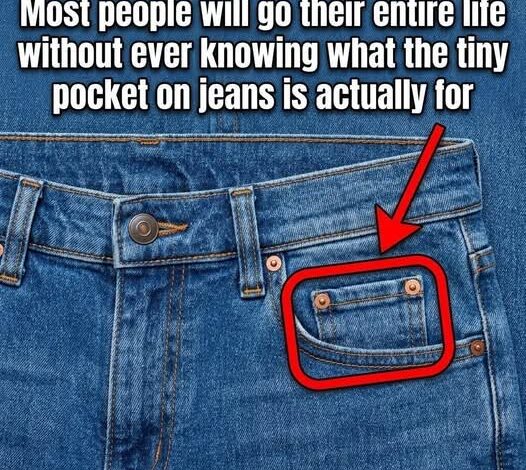
You have been wearing it your entire life, a tiny, seemingly ornamental square of fabric sewn into the corner of your jeans’ front pocket, and you have probably spent years dismissing it as a design flaw or a useless aesthetic whim. But stop for a second and look at it again. That little pocket isn’t there because a designer had extra fabric; it’s there because it was once the absolute center of the industrial world. You are walking around every single day carrying a piece of revolutionary history, a remnant of a bygone era that dictated the survival of the working class.
For generations, we have collectively scratched our heads, wondering why anyone would engineer a pocket so small that it could barely fit a coin, let alone a smartphone or a wallet. Is it for subway tokens? A place to hide a secret key? A designated spot for a stick of gum? The internet is rife with these casual theories, most of which are hilariously wrong. We tend to view modern fashion as a series of aesthetic choices, ignoring the fact that, originally, every stitch, rivet, and seam on a pair of rugged denim trousers had a specific, life-or-death purpose. That tiny pocket is not a mistake; it is a fossil, a leftover evolutionary trait of the garment that literally built the American frontier.
To understand the mystery, you have to travel back to the mid-1800s, a time when the world moved at the pace of steam and muscle. In 1873, Levi Strauss and Jacob Davis patented the copper-riveted waist overall, a garment designed for the rough-and-tumble demands of gold miners, railroad workers, and cowboys. These were men who lived lives of grueling, unpredictable labor, and their tools were their lifeline. Back then, the most expensive and essential personal item for a man wasn’t a sleek touchscreen phone or a high-end credit card; it was the pocket watch.
Pocket watches were the heartbeat of the Industrial Revolution. In an era before synchronized digital clocks, the ability to track time with absolute precision was the difference between arriving at the train station on time and losing your livelihood—or worse, losing your life. A man’s pocket watch was his most prized possession, a delicate, intricate, and incredibly expensive piece of mechanical art. If you were a gold miner working a claim, you couldn’t just throw your watch into a deep, oversized pocket filled with loose nails, mining supplies, and rocks. If it fell out while you were climbing a ladder or crawling into a shaft, it was shattered. If it bounced against your belt buckle or keys, the casing would dent.
The tiny pocket, officially known as the “watch pocket,” was engineered as a high-security vault for this delicate instrument. It was sized perfectly to hold the standard railroad-grade pocket watch of the 19th century, keeping it snug, upright, and protected from the chaos of the larger pockets. When you consider the physical demands placed on those original denim wearers, the genius of the placement becomes obvious. It was situated right at the hip, allowing for quick access so a worker could check the time without breaking their stride or needing to use both hands. It was the original “smart” accessory, a masterpiece of functional design that prioritized the safety of a fragile tool in a hostile, dirt-caked environment.
So why does it still exist in a world where almost no one carries a pocket watch? The answer is a blend of stubborn manufacturing tradition and the cult of the brand. Levi Strauss & Co. is a company that prides itself on its heritage; the design of the original “501” jean is so iconic that any deviation from the original blueprint feels like a betrayal of the brand’s soul. By keeping that tiny, obsolete pocket, the company is effectively keeping a ghost alive. It’s a subtle nod to the garment’s humble origins, a quiet reminder that these jeans were once tools of survival, not just a fashion statement to be worn at a coffee shop.
There is also something undeniably human about our refusal to let the pocket vanish. We are creatures of habit who crave connection to the past, even if we don’t fully understand the origins of that connection. We like the idea that our clothing has a history, a story, and a purpose, even if that purpose has long since been rendered redundant by the march of technology. That tiny pocket serves as a bridge, a subtle, tactile link to a time when people didn’t have smartwatches or AI assistants—they only had their wits, their tools, and the time of day, meticulously tracked and kept safe inside a tiny square of denim.
If you look at the progression of fashion, it is largely a story of stripping away the unnecessary. Over-engineered features are usually the first to be cut to save on manufacturing costs. The fact that the watch pocket has survived over 150 years of rapid industrial change is a testament to its status as a sacred cow of the apparel world. It has survived the transition from the Gold Rush to the Jazz Age, from the Great Depression to the Digital Age, despite being essentially useless for the vast majority of its modern life. It has survived because it is no longer just a pocket; it is a symbol.
When you touch that tiny piece of fabric, you aren’t just touching a design flaw. You are touching the remnants of the Industrial Revolution. You are acknowledging that the modern world was forged by people who needed their pocket watches to stay safe while they hammered, shoveled, and built the foundations of our lives. We may fill that pocket with guitar picks, lighter flints, or loose change now, but in doing so, we are participating in a tradition that is far older and more storied than any modern fashion trend. It is a tiny, silent reminder of where we came from, sewn permanently into the fabric of who we have become. The pocket may have lost its original function, but it has gained a permanent place in the pantheon of iconic design, proving that sometimes, the most “useless” things are the ones that carry the most weight.