The Sinister Secret Hidden in Plain Sight: Why These Mysterious Stars Are Ticking Time Bombs of Ancient Superstition
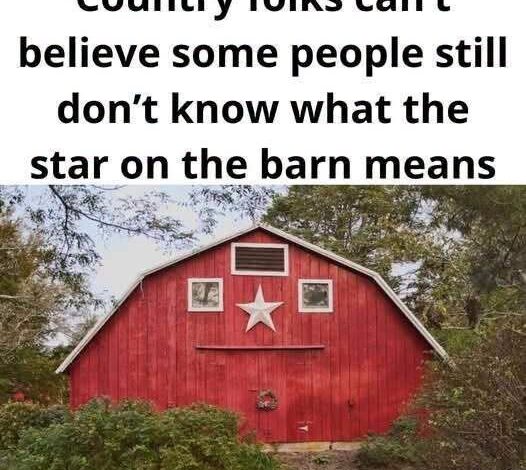
You see them everywhere—those stark, geometrically perfect stars bolted to the sides of weathered barns and suburban sheds, appearing as nothing more than charming, rustic décor. But beneath that innocent layer of paint lies a history so dark and steeped in occult ritual that it would make your blood run cold. What your local home catalog sells as a trendy “farmhouse aesthetic” was once a desperate, calculated weapon of defense against demonic entities, shifting fates, and unseen spirits. You think you’re decorating your porch; in reality, you might be hanging a beacon for forces you can neither see nor control.
Long before they were mass-produced in factories for the modern homeowner, these “barn stars” were far from decorative. They were deeply personal, heavy-handed prayers written in the language of color and sacred geometry. To the Pennsylvania Dutch farmers who originally championed them, these were not mere ornaments; they were “hex signs,” meticulously crafted amulets meant to interact with the spiritual realm. Each shade of paint was not selected for its aesthetic appeal, but for its specific, vibrating power. Red was not just a color; it was a visceral plea designed to draw fortune, passion, and vitality into the home. Blue was a meditative tool, believed to possess the capacity to calm the raging storms within the human mind and, simultaneously, command the chaos of the skies above.
Green was the color of survival, invoked to coax life from a stubborn, barren soil, while black—the most mysterious of them all—was painted with a chilling intention: to guard the inhabitants against the unseen, malicious harm of enemies both living and dead. These signs were intimate, binding contracts with fate itself, layered with symbols that blurred the lines between devout Christian faith, ancient folk superstition, and an unyielding, territorial identity. Every stroke of the brush was a deliberate act of protection, a way to anchor a family’s existence to the physical land while shielding them from the intangible threats that supposedly haunted the rural darkness.
As the centuries rolled on, the practice of traditional agriculture shifted, the old beliefs softened, and the rigid superstition faded into a more generalized folklore. Yet, the stars remained. They persisted, transitioning from potent, magical talismans into a form of silent, ancestral testimony. They became markers of human endurance, quietly documenting who built the structure, who toiled upon the land, and who staked their hopes on the changing seasons. When you look at one today, bolted to a shed or hanging over a suburban front door, you are witnessing an evolution of intent. The original, frantic fear of the occult has been replaced by a more poignant, human instinct: the desperate desire to leave a mark in a world that is obsessed with forgetting.
There is a profound loneliness in the human experience that these stars attempt to bridge. When a person mounts a star to their barn, they are doing more than following a design trend; they are performing a silent, architectural act of defiance. They are declaring that their story, no matter how small, how rural, or how inconsequential it might appear to the outside world, will not vanish into the ether unnoticed. It is a stubborn, visual scream against the inevitable erasure of time. Even if the original meaning behind the hex has been scrubbed away by the progress of modern history, the core impulse remains: to claim a space, to define a boundary, and to tell the world, “I was here.”
Furthermore, the geometry of these stars holds a fascination that transcends their religious roots. The symmetry and the mathematical precision speak to an ancient human craving for order in a chaotic universe. By placing a balanced, five-pointed or eight-pointed star on a structure, the builder is effectively framing their daily struggle—the back-breaking work of the farm, the unpredictability of the weather, and the fragility of family life—within a container of perfect equilibrium. It is an attempt to impose stability on a life that is fundamentally unstable. The star serves as an anchor, a visual point of reference that suggests that behind the mess of reality, there is a design, a plan, or at the very least, a pattern.
This evolution from the occult to the aesthetic reveals something deep about our collective psyche. We have a tendency to take the tools of our ancestors and strip them of their original, terrifying power, turning them into mere icons. We have turned ancient wards against demons into cute accent pieces for our living rooms. In doing so, we might have lost the original protective magic, but we have gained a new kind of resonance. We no longer believe that a black star will literally ward off a malevolent spirit, but we still feel the comfort of the tradition. We are still participating in the ritual of marking our territory, of claiming our homes as sanctuaries from the relentless, uncaring nature of the outside world.
When you see a star on a barn today, do not be fooled by its weathered paint or its mass-market appearance. It is a link to a time when people lived with one foot in the tangible world and one foot in the spectral, a time when a simple geometric shape was the difference between a harvest saved and a crop destroyed. It is a symbol of a forgotten world where humans believed they had the power to negotiate with fate. That power may have faded, but the human desire to be seen, to be remembered, and to be protected remains as potent as ever. The next time you pass a farmhouse and notice that silent, geometric sentry staring back at you from the wood, remember that you are looking at a legacy. You are looking at a physical manifestation of a family’s hope, a farmer’s toil, and an individual’s quiet, enduring insistence that their life has meaning. The superstitions may have withered, but the star, and the story it carries, refuses to fade away.