The Green Light Mystery: Why You Are Seeing These Bizarre Flashing Lights and Why You Need to Stop Panicking
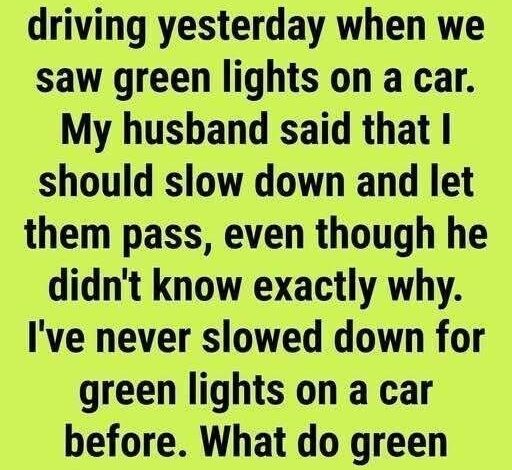
You’re cruising down the highway, minding your own business, when suddenly, your rearview mirror fills with a piercing, strobe-like flash of neon green. Your heart skips a beat. Is it an unmarked police car? A high-tech emergency response unit? You instinctively tap your brakes, preparing to pull over, but something feels off. These aren’t the red and blue lights you’ve been trained to fear and obey—they are something else entirely. What are these mysterious vehicles, why are they suddenly swarming our roads, and are you accidentally breaking the law by ignoring them? The answer is more complex than you think.
For years, the driving public has been conditioned to associate specific light colors with specific levels of authority. Red and blue lights mean “move over, pull over, or get out of the way immediately.” They represent the apex of road authority, belonging exclusively to police, firefighters, and paramedics. When we see those colors, our autonomic nervous system kicks into gear, pushing us toward the shoulder of the road. But the introduction of flashing green lights has thrown a massive, confusing wrench into this well-oiled social contract. Drivers across the country are left in a state of paralysis, wondering if they are about to be ticketed for failing to yield to a vehicle that technically might not have the power to demand it.
So, what is the reality behind the emerald glow? In most jurisdictions, these vehicles are not law enforcement or front-line trauma response units. They are categorized as authorized community service vehicles. These are the workhorses of the modern medical transportation industry, tasked with a vital but distinctly non-emergency role. They might be transporting elderly patients to essential dialysis appointments, assisting individuals with limited mobility to and from physical therapy, or performing routine health services that require specialized logistics. They use green lights not because they are rushing to a burning building or a crime scene, but because they need to be seen in the chaos of modern traffic.
The most important takeaway for the average driver is this: green lights do not automatically grant a vehicle emergency priority. Unlike the sirens and oscillating red-and-blue patterns that trigger a legal obligation to yield, green-lighted vehicles operate under the standard rules of the road. You are not legally required to veer onto the shoulder or come to a screeching halt when you see them. They are subject to the same speed limits, stop signs, and traffic signals as your own car. If a green-lighted van is behind you, you are not obligated to treat them like a police cruiser in pursuit of a suspect.
However, just because there is no legal requirement to pull over doesn’t mean you should be dismissive. The use of these lights is a signal—not of authority, but of necessity. These vehicles are transporting people who may be in fragile health, perhaps dealing with chronic pain, or who are otherwise vulnerable. When you see that green strobe, it is a request for a bit of extra patience. If it is safe to do so, providing these vehicles with a little more space, avoiding sudden maneuvers near them, or being mindful of their often-slow movements can significantly improve the safety and comfort of both the driver and the patient inside. It is a courtesy that speaks to the level of humanity we bring to the road.
The confusion is further exacerbated by the fact that traffic laws are not universal. Because the United States operates under a fragmented system of state and local governance, the laws regarding green warning lights vary wildly from one region to another. In some states, these lights are strictly regulated and authorized only for specific medical transport fleets. In other areas, the use of green lights is more informal, functioning more like a “courtesy signal” that a driver is operating a transport vehicle that requires a little extra care. Because of this lack of standardization, the average driver can never be 100% sure what the law is just by crossing a state line. This inconsistency is the primary driver of the road rage and confusion we see on our highways today.
Ultimately, the proliferation of these lights serves as a poignant, if jarring, reminder that not every “important” journey is a life-or-death emergency. We spend so much time on the road viewing everything as a race—the police, the ambulance, the delivery truck, the impatient driver in the lane next to us. When we see a green light, it is a chance to break that cycle of urgency. It is an opportunity to practice a bit of grace. Staying calm, patient, and respectful when you encounter these vehicles is not just about avoiding a fine or obeying a statute—it is about ensuring that the most vulnerable members of our community can reach their care appointments with as little stress as possible.
The next time you see that green flash in your mirror, don’t let your heart rate spike. Don’t let your frustration boil over, and don’t feel the need to break your neck to get out of their way. Take a breath, assess the situation, and remember that there is a human being behind that windshield who is just trying to get to a doctor, a clinic, or a support group. By choosing patience over urgency, we make the road a little bit safer for everyone, turning what could be a moment of road-bound chaos into a silent, shared act of kindness. The lights are bright, yes, but the responsibility they ask of us is quite simple: be aware, be kind, and keep driving with the understanding that we are all on a journey, even if some of us are traveling a bit more slowly than others.