A Father’s Worst Nightmare: After a Horrific Acid Attack Left Him Unrecognizable, Would His Own Toddler Still Love Him?
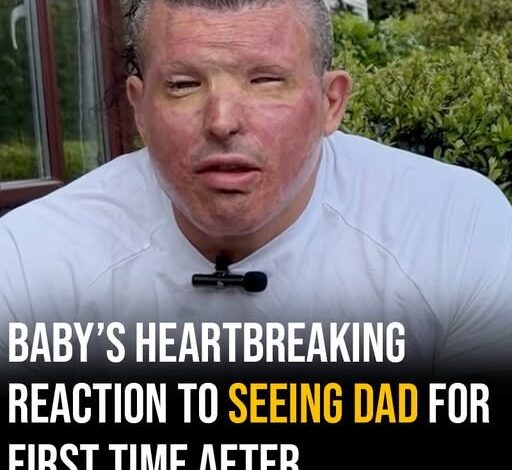
The knock at the door was the beginning of an unimaginable, life-altering horror that no human should ever have to endure. Andreas Christopheros was a happy 29-year-old family man living in Truro, Cornwall, until a stranger appeared on his doorstep and unleashed a pint of concentrated sulphuric acid directly into his face. In an instant, the world turned into a screaming, burning inferno. The attacker, who had targeted the wrong house and the wrong person, left Andreas blind in one eye and covered in agonizing, permanent burns. Yet, in the sterile silence of the hospital, his greatest fear wasn’t death—it was the prospect of his eighteen-month-old son looking at him and seeing a monster.
The attack took place in December 2014, a moment of pure, unadulterated evil. Andreas recalls seeing a red van pull up to his home, initially assuming it was a colleague’s vehicle. When he opened the door, a stranger stood there, cold and detached, and delivered the devastating payload with a casual, chilling, “This is for you, mate.” As the acid began to dissolve his skin, Andreas sprinted through his home, desperately trying to douse his burning body in the kitchen sink while screaming for his wife, Pia, to call for help. He remembers the ambulance arriving, and then, the comforting, heavy descent into a medically induced coma.
When he finally woke up six days later in the intensive care unit, his life had been irrevocably dismantled. The road to recovery was not just a medical challenge; it was a grueling odyssey of endless surgeries, skin grafts, and the profound psychological weight of having his identity stolen by a random act of violence. While he navigated the nightmare of rehabilitation, his mind was constantly preoccupied with one specific person: his toddler son, Theo.
For four agonizing months, Andreas was kept apart from his young child. His wife and family made the heart-wrenching decision to keep Theo away from the hospital, shielding him from the visual horror of his father’s injuries. Andreas agreed, knowing that a toddler needs love, toys, and stability—not the sight of a broken body. But as the days turned into weeks, the silence was “soul-destroying.” He lay in his hospital bed, haunted by a singular, gnawing insecurity: Will my son recognize me? Will he be terrified of the man I have become?
The reunion finally came, but it was far from the perfect scene he had imagined. When Pia brought Theo to see his father for the first time after the attack, the toddler took one look at Andreas, didn’t recognize the features that had been scorched away, and instinctively clung to his mother for safety. It was a moment of profound, stabbing pain for Andreas—a realization that the man his son remembered simply didn’t exist anymore. But just as the heartbreak seemed absolute, Andreas spoke.
As soon as Theo heard his father’s familiar, loving voice, the confusion vanished. In an instant, the toddler understood. The connection that existed beneath the surface—the bond of a parent and child—was stronger than the disfigurement of his father’s face. Theo reached out his small arms, and when he finally hugged Andreas, he refused to let go. That long, tight embrace was the catalyst Andreas needed to truly begin his journey back to himself. It proved that while his exterior had been stolen by a stranger, the core of who he was as a father remained completely, resiliently intact.
The perpetrator, David Phillips, was later caught and sentenced, a small measure of justice in a sea of trauma. Phillips initially received a life sentence, which was later reduced on appeal to 16 years, with parole eligibility after eight. Yet, for Andreas, the focus shifted away from the man who ruined his life and toward the life he was still determined to lead. Over the past decade, he has transformed from a victim into a powerful, vocal advocate for victims of acid attacks. He found that the tragedy, while devastating, opened doors to a life of service and perspective he never could have anticipated before that fateful day in 2014.
Andreas is the first to admit that the trauma never fully disappears. He acknowledges the pain of his lost eyesight and the daily reminders of the burns that changed his face. But he also speaks of a life that has become “very interesting” and “very different.” He doesn’t want pity; he wants to be recognized for the journey he has carved out for himself. “It’s changed me as a person,” he says, reflecting on his transformation. “I’m really proud of the journey I’ve taken to get to where I am now.”
True to his word, Andreas continues to move forward with unyielding spirit. He is currently channeling his energy into supporting Face Forward International, a Beverly Hills-based charity that provides reconstructive surgery for victims of violent crimes. To raise funds and awareness for the organization, he is preparing for a Herculean physical challenge: in September 2026, he plans to cycle 450 miles from Cornwall to Paris in just four days. It is a grueling, ambitious goal, but one that is perfectly in line with the man he has become—someone who refuses to be limited by what was taken from him.
Andreas Christopheros’s story is a harrowing reminder of how quickly a life can be shattered, but it is also a testament to the unshakeable nature of love. He was forced to face the most terrifying question a parent could ever ask, and he found that love doesn’t reside in the perfection of our features or the symmetry of our faces. Love resides in the voice that comforts, the arms that hold, and the spirit that refuses to break. Even when he was unrecognizable to the world, he remained the exact same father to his son, proving that some bonds are forged in a depth that no amount of acid can ever touch. His journey from that burning doorway to the finish line in Paris is not just a recovery—it is a reclamation of his humanity.