The Exploding Danger In Your Passenger Seat: Why That Water Bottle Could Torch Your Car!
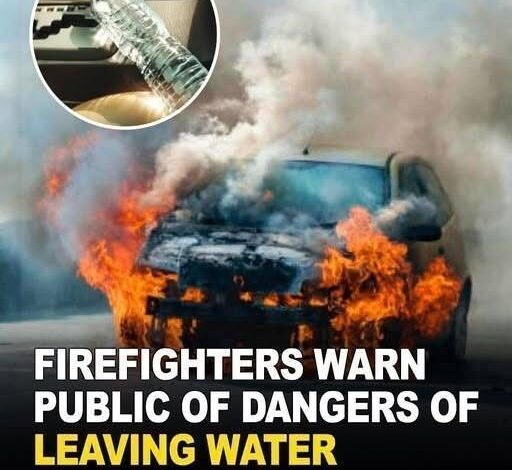
You park your car on a sweltering summer afternoon, grab your belongings, and leave a half-empty water bottle sitting in the cup holder—a seemingly innocent habit, right? Wrong. You have unknowingly placed a ticking time bomb in the heart of your vehicle. Firefighters are sounding a desperate alarm about a terrifying, little-known phenomenon where that clear plastic bottle acts as a high-powered magnifying glass, focusing the sun’s intense rays into a lethal beam of heat. In a matter of minutes, this simple oversight could trigger a chemical reaction that leaves your car interior melted, scorched, or completely engulfed in flames.
It sounds like the premise of an urban legend, something whispered on internet forums to scare parents, but the physics behind it are indisputable. When sunlight passes through a clear, water-filled container, the water acts as a convex lens. Just as you might have used a magnifying glass as a child to focus sunlight onto a leaf, the water in your bottle concentrates the solar energy into a tiny, hyper-focused point of heat. If that intense beam happens to land on a dark, flammable surface—like your dashboard, a fabric seat, or a pile of discarded receipts—the temperature at that point can skyrocket to levels capable of causing ignition.
The dramatic stories circulating online often paint a picture of catastrophic destruction: melted dashboard plastic dripping onto the floor mats, seats smoldering, and shattered glass resulting from the rapid, localized heat expansion. While these accounts are often presented with a sensationalist flair, the underlying danger is real. A closed vehicle in the summer acts like a greenhouse, trapping heat and magnifying the intensity of the sun. Even if a full-blown fire is rare, the potential for permanent cosmetic damage to your car’s interior is a high probability. Nobody wants to return to their vehicle only to find a perfectly circular burn mark branded into their expensive upholstery or a warped, unusable cup holder.
Critics of these warnings are quick to point out that actual vehicle fires are far more frequently caused by electrical faults, engine malfunctions, or fuel system issues rather than passive sunlight refraction. They are absolutely correct. The statistical likelihood of a random water bottle causing a total loss of a vehicle is exceptionally low. However, this fact often leads to a dangerous sense of complacency. Just because an event is statistically rare does not mean the hazard is nonexistent. In the realm of public safety, we often disregard “low probability” events until the moment they happen to us. By dismissing the danger entirely, we ignore a simple, easily preventable habit that could save us a great deal of money and stress.
The primary takeaway from these firefighter warnings shouldn’t be paranoia, but rather a shift toward proactive, common-sense car maintenance. We are constantly reminded to keep our homes free of fire hazards, yet we often treat our cars like mobile junk drawers, filled with flammable clutter, old paper, and heat-sensitive items. Clearing out the debris is not just about aesthetics; it is about minimizing the fuel load in your vehicle. If you make it a habit to remove your water bottles, trash, and loose papers every time you exit the car, you are effectively eliminating the risk entirely. It is a small behavioral change that pays dividends in safety and vehicle longevity.
If you must keep water in your car, the solution is remarkably straightforward: switch to opaque containers. Stainless steel, aluminum, or thick, solid-colored plastic bottles do not refract light. They are perfectly safe to leave on the seat or in the cup holder, even in the blistering heat of July. By making this simple swap, you remove the “lens” that makes the refraction possible. Furthermore, considering the use of a sunshade for your windshield is one of the most effective ways to protect your interior. Not only does it keep the temperature of the cabin significantly lower, but it also prevents the sun from reaching the surfaces where a focused beam of heat could do the most damage.
This cautionary tale also highlights a broader issue: how we process information in the digital age. We are constantly inundated with “viral warnings,” many of which are exaggerated, outdated, or outright fabricated. It is natural to feel skeptical when you see a dramatic, alarmist post about a household object. However, the goal of these stories is often to steer the public toward safer habits, even if the danger is slightly amplified for effect. In this case, the message is grounded in actual physics. Even if a water bottle fire is an “extreme” scenario, the core advice—to keep your car clean and free of unnecessary clutter—is objectively good practice.
We must also consider the hidden dangers of the environment itself. The summer heat is not just a nuisance; it is an active force that changes the physical properties of the items we leave in our cars. Beyond water bottles, think about hand sanitizers, aerosol cans, lighters, and electronic devices with lithium-ion batteries. All of these items react poorly to the extreme, trapped heat of a closed vehicle. A car interior can easily reach temperatures exceeding 140°F (60°C) on a sunny day. At those temperatures, materials degrade, batteries swell, and pressure-sensitive containers can burst. By keeping your car free of these items, you are not just preventing a potential fire; you are preserving the structural and aesthetic integrity of your vehicle.
As we move through the heat of the season, let this be a reminder to take a few seconds before you walk away from your parked car. Look at your seats. Look at your cup holders. Ask yourself if there is anything in the vehicle that shouldn’t be there. That quick scan could be the difference between a pleasant return trip and a costly, stressful cleanup. Safety is not about living in fear of every bottle or scrap of paper; it is about cultivating a mindset of awareness. We have the power to control the environment inside our vehicles, and the choices we make—no matter how small—contribute to our overall safety. So, next time you park, take that bottle with you. It’s a tiny, effortless action, but it’s one that keeps you, your passengers, and your property out of harm’s way, leaving the only thing to worry about in the heat being how quickly you can get the air conditioning running.