The Ghost of Heron Road: A Bike Crash Revealed the Heartbreaking Truth About My Missing Daughter
For twenty years, I lived in a purgatory of silence and sorrow, haunted by the vanishing of my six-year-old daughter, Emma, from a quiet café on Heron Road. The police had long since abandoned the case, leaving me with nothing but ghosts and the crushing weight of a mystery that had stolen my entire world. I had avoided that road for two decades, terrified by the memories it held, until a freak bicycle accident threw me headlong onto that very stretch of asphalt. But when a mysterious stranger helped me up and handed back my cap, she sparked a firestorm of revelation that would change my existence forever.
At fifty-eight, my life was a monochromatic routine defined by grief and the lonely habit of Saturday morning rides. After my wife, Margaret, passed away, the world felt fragile, but when Emma disappeared, it shattered completely. One moment she was asking to use the café bathroom, and the next, she had evaporated into thin air. There was no struggle, no witness, just a profound, hollow silence that echoed through my house for the next twenty years. On that Saturday morning, as I pumped my tires in the garage, I decided to take a longer route, a subconscious decision that steered me back to the epicenter of my greatest agony.
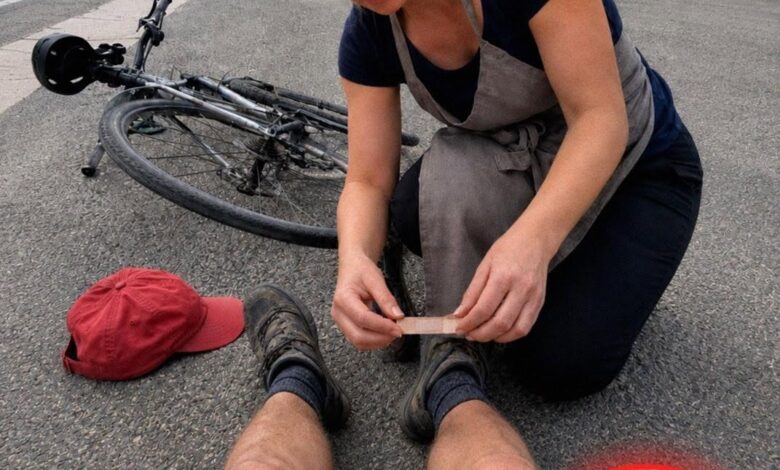
The road rose before me, deceptively tranquil in the early sun. As I climbed the familiar incline, the world suddenly tilted. A wave of dizziness washed over me, sending dancing white spots across my vision, and before I could react, I was tumbling hard onto the coarse asphalt. My palms were shredded, my knees split open, and my cap went skidding into the dirt at the shoulder of the road. As I sat up, gasping for air and clutching my throbbing hands, the horror of my location hit me. I was sitting exactly where Emma had last been seen. I was anchored in the center of a two-decade-old nightmare.
A woman jogged toward me from the café, her face a mask of professional concern. She was in her thirties, dark-haired and steady-handed. She cleaned my wounds with an efficiency that felt oddly rehearsed. While she patched my knee, she studied my face with an intensity that made the hair on my arms stand up. When she handed me my cap, her eyes lingered on mine. “Nice to meet you, Robert,” she said, her voice dropping into a tone of peculiar, knowing recognition. She walked away before I could process the gravity of the encounter, leaving me to limp home with a mind fractured by a thousand impossible questions.
Once I reached my bathroom, I peeled off my sweat-soaked gear and lifted my cap from my head. As I did, a small, worn photograph fluttered onto the tile. I gasped, dropping to my knees as the room began to swim. It was a picture of Emma at four years old, wearing the red sweater her mother had hand-knitted for her, her smile wide and crinkled. I had never seen this photograph in my life. I flipped it over, and my breath hitched. In careful, deliberate handwriting, the note read: “She didn’t disappear, Robert. I know where. I’ve been waiting twenty years for you to come back to that road. Go to this address. Come alone. Tell no one. You have 24 hours.”
The address was only twelve miles away, a location I knew well—three houses down from my late grandmother’s old home. The coincidence was too precise to be random. My heart hammered against my ribs, an urgent, frantic rhythm that pushed aside my terror. I didn’t call the police; twenty years of their inaction had taught me that I was the only one who would ever fight for her. I grabbed my keys, the photograph clutched in my trembling hand, and drove toward the river, my mind replaying the steady, calm eyes of the woman at the café.
I reached the address and walked up to the door of the cabin, the scent of cedar and damp earth greeting me like a long-forgotten memory. The door swung open before I could knock. The woman from the café stood in the hallway, her composure finally showing a hairline fracture. “You came,” she said quietly. Before I could demand answers, she pointed to a door at the back of the cabin. “The little girl who disappeared from Heron Road never forgot her father. My name is Sarah, and two years ago, a young woman walked into our café asking about a missing child. She’s here, Robert.”
The door opened, and the world simply ceased to exist. Standing there was a woman in her twenties, the echoes of my daughter’s face unmistakable in her features. “So you did come,” she whispered. My knees buckled. “Emma?” I choked out, a sound of pure, ragged disbelief. She began to cry, and for a moment, the chasm of twenty years seemed to bridge. I poured out my agony—how I had never stopped looking, how the pain had hollowed me out.
But then, the betrayal revealed itself. Emma explained that she had been told a lie so profound it had anchored her entire life in a false reality. My own sister-in-law, Diane, had taken her that day. Diane had convinced a six-year-old child that I had requested she take her, that I didn’t want her anymore. She had raised Emma under a different name, crossing state lines, building a web of deception that kept my daughter trapped in the shadow of a woman who had played the role of savior while acting as a kidnapper.
My rage was a cold, searing thing, but as I looked at Emma, I realized that my own vengeance was secondary to her healing. We drove back to Diane’s house, Emma leading the charge. When the door opened, Diane’s face turned the color of ash. The confrontation was not a scream-filled argument, but a cold, clinical dismantling of Diane’s lies. Diane attempted to frame her abduction as an act of mercy, but Emma’s quiet resolve silenced her. She was no longer the six-year-old who trusted her aunt; she was a woman reclaiming her history.
As we drove away, leaving Diane to the legal fallout that was inevitably coming, Emma reached across the console and took my hand. We were two strangers who shared a past, navigating the terrifying, beautiful space of a future we had both assumed was impossible. I promised to be there for every second of the coming storm, every legal battle, every tear, and every healing moment. Outside the window, the road unspooled, no longer a path of ghosts, but a gateway to a life I had never stopped praying for. For the first time in two decades, the road wasn’t just leading me forward—it was bringing me home.