The Secret in the Basement: What My Grandfather Really Did the Day My Parents Died
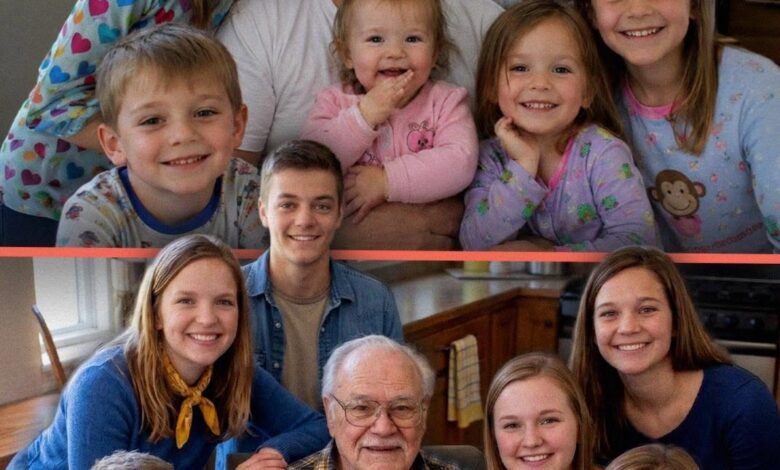
For seventeen years, I believed my grandfather was a hero who had stepped in to save my siblings and me from the ashes of a tragic house fire. I lived by the stories he told, the meals he cooked, and the gentle way he brushed our hair, convinced he was a saint who had sacrificed his own peace to raise six broken children. But standing over his open casket, a mysterious stranger slipped me a note that shattered my reality. He wasn’t the saint I worshipped—he was keeping a bone-chilling secret about what really happened to my parents that day.
The chapel was thick with the scent of lilies and the oppressive silence of a life coming to its final end. Standing beside Grandpa Harold’s casket, I felt the familiar pull of grief dragging me backward in time. I was thirty-two now, a paralegal who made a living reading the fine print, but in the presence of his body, I was suddenly the eldest child again, standing in the ruins of the summer house, desperate for an explanation for the fire that had claimed my parents. I had asked him about that day a thousand times during my childhood, only to be met with his distant gaze and the plea, “Some memories burn a man twice, Elena. Let me carry it.”
As the last mourners filed out, the chapel emptied, leaving me alone with the long, jagged shadows cast by the stained glass. That was when I felt it—the unmistakable, icy weight of eyes boring into the back of my neck. I turned to see an elderly woman in a heavy coat and a faded headscarf standing by the back pew, her expression unreadable. She walked toward me with a slow, deliberate grace, her eyes locked on the casket. She didn’t offer condolences; instead, she pressed a folded piece of paper into my palm and whispered, “If you want to know what really happened to your parents, read this. Read it alone. Don’t tell the others yet.”
Before I could demand an answer, she turned and vanished into the gray afternoon, leaving me trembling in the silence. I didn’t open the note until I was back at Harold’s house, sitting at the kitchen table where he had spent years sewing our clothes and pretending he didn’t hear us crying at night. The note was brief, its message a dagger: “Your grandfather was at the summer house that morning. There are papers in his house. Look where he never let you look.” My heart plummeted. He had always told us he was in the city that weekend. If that was a lie, then what else had he been hiding?
My search led me to the one place we were always strictly forbidden: the basement. Harold had told us the stairs were rotten and the space was a dumping ground for mice and rust. But as I pulled the brass key I found hidden behind his desk and unlocked the door, I found something entirely different. The stairs were sturdy, perfectly swept, and clean. At the bottom stood a dark wood cabinet—the same one from our family home that I thought had perished in the fire. My hands shook as I opened the drawer, revealing a cache of documents that would rewrite my entire history.
There were letters, insurance records, and photographs. The photos were the most brutal—images of my parents standing in the driveway, their faces contorted in raw, blistering anger, with Harold standing between them like a shield. I pulled out a bundle of letters tied with twine. My grandfather had been trying to bail my father out of massive financial ruin, paying his debts, pleading with him to respond, and being met with the cold, defiant instruction: “Stay out of it. The house is mine. I will handle it my way.”
At the bottom of the pile lay a handwritten confession, the paper soft and worn from years of being touched. “I went to the summer house that morning. There was an argument in the kitchen. Then the blast came. I survived. They did not.” I felt the world tilt. My grandfather hadn’t just been a witness; he had been present when the fire started. He had spent his entire life nursing the guilt of that morning, convinced that his presence in that argument had been the catalyst for the tragedy.
I reached out to the woman, Margaret, who had left the note. She lived next door to the summer house for four decades. Her voice was steady, even over the phone. “I came outside after the blast,” she explained. “Your grandfather was already on the lawn, on his knees, watching the house burn. I assumed he had run out just as it exploded, but I never saw him leave the porch. He didn’t go back in after I got there.” She told me she had kept silent for seventeen years because she saw him raising six orphans with a dedication that bordered on penance. She had decided that watching him struggle to keep us fed and sheltered was punishment enough for whatever sins he had committed that morning.
I hung up and sat in the dark kitchen, the confession folded in my coat pocket like a ticking bomb. My siblings were at the reception, oblivious to the fact that their foundation was built on a foundation of hidden agony. I felt a surge of rage, but it was quickly replaced by a profound, hollow ache. I looked at the kitchen table—the site of so many homework sessions and quiet, broken-hearted breakfasts—and realized that the lie had been the mortar holding our family together. Harold hadn’t just been hiding a crime; he had been burying his own heart to keep us from drowning.
That evening, I gathered my siblings and read the confession aloud. Lily, Marcus, and the others wept as they heard the truth for the first time—that Harold had mortgaged his own home to make sure our parents’ life insurance policies, which had lapsed due to my father’s secret debt, would pay out for our care. He hadn’t just lied; he had traded his future, his home, and his peace of mind to ensure that we never knew we were destitute. He had lived every single day of his life in the shadow of that explosion, terrified that if we knew the truth about the argument, we would see him as the villain who drove our father to ruin.
The following morning, I went back to Margaret’s house. I didn’t come with accusations; I came with the relief of a truth finally unearthed. “Can you forgive an old woman for waiting so long?” she asked, her eyes wet. “I already have,” I replied. I left her house and drove to the cemetery, standing over Harold’s fresh grave. I realized then that the man I had worshipped for his kindness was far more complex, and far more human, than I had ever dared to imagine. He had failed to save my parents, but he had spent the rest of his life failing to fail us. I laid a single white rose on the earth, finally understanding that love isn’t always a clean, heroic story; sometimes, it’s a jagged, ugly lie told to keep the light burning for the people you are terrified to lose.