Ranger Father Confronts Corrupt Sheriff After His Son Returns Home With A Broken Bone
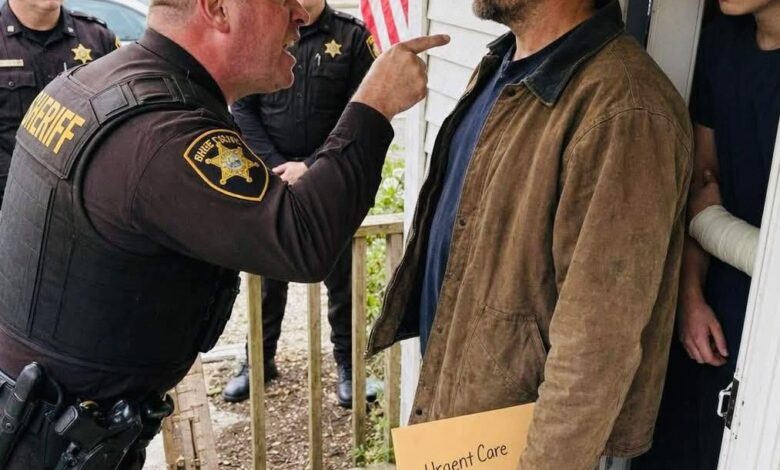
The silence in my truck was heavier than any I had known during my twenty years in the service, but it was the silence of a man holding back a storm. My son, Drew, sat beside me, his body rigid and his arm cradled against his chest, shielding a secret that screamed louder than any confession. When we arrived at the hospital, the X-ray confirmed my worst fear: a clean, sharp fracture in his bone. Someone had deliberately hurt my boy, and in this small town, I knew exactly who held the power to prevent it—and who was choosing to ignore it.
We had moved to Milwood Creek fourteen months ago, seeking a quiet life after my retirement. I was a man who understood danger, and I had been the one to take Drew when his mother and I decided our marriage was a lost cause. Milwood Creek was the type of place where people knew your business before you reached the checkout counter at the grocery store, a town of three thousand people governed by a conditional warmth that was always held in reserve. Sheriff Carl Gaines had been the king of this county for as long as anyone could remember, a man who had never been seriously challenged and had long ago mistaken his own absolute ease for the natural order of things.
His son, Neil, was the source of the rot. Neil was seventeen, loud, and physically imposing, the kind of boy who took up too much space and expected the world to move for him. I had watched him on the first day of school, standing near the entrance, not quite blocking it but making sure everyone knew he had the power to do so if he felt like it. He was a bully, but he was the Sheriff’s son, which meant the teachers turned their heads, the other students learned to stay quiet, and the local law enforcement regarded him as an untouchable prince of the county.
Drew had initially mentioned the boy as “some guys,” and then eventually “Neil,” before settling into a terrified, enforced silence. I knew the look of a child who had realized that naming his tormentor only made the punishment worse. The morning I dropped Drew off at school, I had watched Neil leaning against the brick wall near the entrance, laughing with his friends. He didn’t look at Drew; he looked at me. It was a smile that didn’t belong to a teenager—it was a challenge, a declaration of ownership over the space and the people within it. I had to restrain every instinct I had developed over two decades of active duty, knowing that an explosive reaction would only land on my son’s shoulders.
By the time I picked him up that afternoon, the truth was walking toward me in the form of a boy struggling to hide his agony. Drew walked with the measured, cautious steps of someone trying to avoid jarring a broken part of his body. He climbed into the truck without a word, his face deathly pale. I turned toward the urgent care clinic, and he didn’t even ask why. That lack of curiosity, that resignation, was the most painful thing I had ever witnessed. In the waiting room, I watched the nurse take note of his jaw, his arm, and my own rigid posture. She didn’t need to ask for a police report; she could read the violence in his frame.
The fracture was undeniable. Standing in that exam room, staring at the white, jagged line across the X-ray film, I felt a calm, cold clarity descend upon me. I was a man who had been trained to handle threats, and I had spent months trying to calibrate my life to the “normalcy” of this small town. I had lied to myself, convincing myself that teenage horseplay was the culprit and that I was just a paranoid father unable to let go of my protective instincts. Now, the lie was gone. The threat to my son was real, it was systematic, and it was being enabled by the man who was supposed to uphold the law in this county.
I knew that Sheriff Gaines lived in the comfort of a man who had never been held accountable. He knew who owed money, he knew whose kids were getting in trouble, and he knew how to make families disappear into the background if they became inconvenient. He was the architect of the silence that allowed a boy like Neil to break the bones of another student without a single consequence. I had spent twenty years learning how to keep things contained until the right moment. The moment had arrived, and as I looked at my son’s pale face, I knew my military discipline was no longer a cage for my anger—it was a precision instrument for my response.
We left the clinic with a cast and a set of instructions, but I knew the healing would take more than medicine. Driving home, the roads of Milwood Creek seemed to narrow, the quaint storefronts looking more like facades for a decaying moral center. I didn’t say much to Drew, not because I didn’t want to comfort him, but because words would have sounded thin and hollow in the face of what needed to be done. He needed his father to be more than a protector; he needed me to be the force that finally broke the cycle of fear that had paralyzed him.
The town would wake up tomorrow expecting the same quiet compliance they had always received. They would expect the Sheriff’s son to walk the halls with his usual arrogance, and they would expect me to file a useless report that would end up in a shredder in the back of the station. They were wrong. I had been patient, I had been restrained, and I had been watching. The Sheriff had built a kingdom of ease, never once considering that someone would eventually walk into his office who wasn’t afraid of his badge. Tonight, the silence would end. I knew exactly where I was going, and for the first time since we moved to this town, I didn’t feel like a stranger waiting to be accepted. I felt like a man fulfilling a duty I had spent my entire life preparing to execute.