THE SHOCKING PSYCHOLOGICAL TRUTH BEHIND WHY MEN HAVE SPECIFIC HEIGHT PREFERENCES
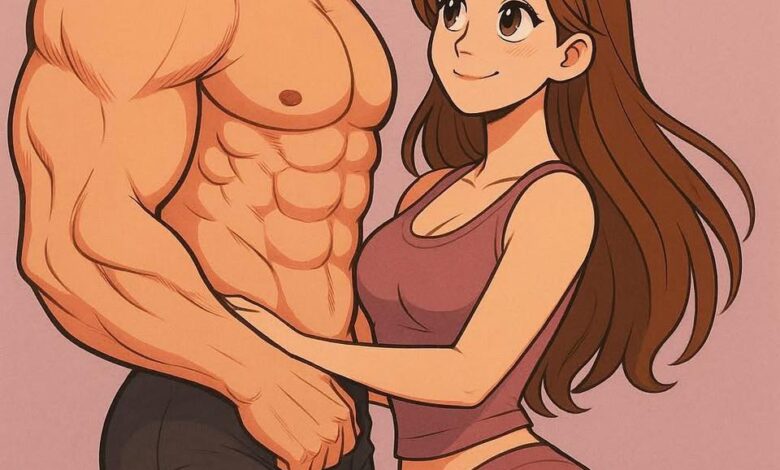
You think a man’s obsession with a woman’s height is just a random physical preference, but you are dead wrong. This seemingly innocent attraction is actually a massive, flashing neon sign revealing his deepest insecurities, his desperate need for control, and his secret, fragile ego. Whether he craves a woman who makes him feel like a titan or one who makes him feel like a king, his choice is never actually about her—it is entirely about him. The hidden power dynamics at play will stun you, and once you understand this, you will never look at a couple the same way again.
Beneath the superficial chatter regarding dating preferences and aesthetic types, a man’s fixation on a partner’s height often exposes his private, internal negotiations with power, security, and ego. It is a subtle dance of projection, where the physical stature of a woman serves as a canvas upon which he paints his own self-perception. Tall women, in the collective unconscious of dating society, are frequently cast as alpha figures. They are perceived as ambitious, assertive, and high-status, possessing an inherent command over the space they occupy. A man who actively pursues a taller partner is often signaling something profound about his own psyche. He may crave the thrill of a challenge, a deep desire for the external admiration that comes with being seen beside someone who commands a room, or even a competitive drive to prove his own worthiness by standing beside a woman of perceived superior stature. For many, it is not just attraction; it is aspiration, or in some complex cases, a manifestation of competition in disguise.
Conversely, short women are quietly, and often unfairly, coded as safe within the traditional dating framework. They are frequently framed as the embodiment of the nurturing, gentle, and approachable ideal. Men who find themselves consistently drawn to shorter women may be seeking a specific brand of comfort—an unspoken expectation of caretaking or a need for someone who acts as a soft counterpoint to the sharp, often aggressive edges of their own insecurity. There is a psychological comfort in being physically larger, as it reinforces a traditional, ancient model of protection and dominance that can soothe a man who feels fragile in other areas of his life, such as his career or his social standing. Neither of these archetypes is inherently better, and neither is inherently more moral; they are simply mirrors reflecting the unresolved internal needs of the man who holds the preference.
When a man insists on towering over his partner, or conversely, expresses an intense, almost obsessive love for being physically dwarfed by her, he is revealing exactly how he wants to feel in the context of love. Height, in this sense, becomes a metric for his emotional bandwidth. It is a tangible way to calibrate his own feeling of strength or vulnerability. A man who insists that his partner be shorter may be desperately trying to curate a world where his authority is physically undisputed, whereas a man who prefers a taller partner may be looking for a peer—or a superior—to help him feel elevated and legitimized. The height of the woman is the variable, but the man’s ego is the constant, driving force behind the selection process.
Modern dating has attempted to strip away the weight of these traditional gender expectations, yet the obsession with height remains one of the most stubborn, entrenched patterns in human courtship. We talk about chemistry and compatibility, but we rarely talk about the architecture of ego that precedes that chemistry. We rarely ask why a man feels the need to be the physical protector, or why another man feels he needs a woman who stands as a status symbol beside him. These preferences are often established long before a man ever meets a partner, rooted in the foundational stories he was told about what a man should be and what a woman should offer him.
We must also recognize that these preferences are frequently reactionary. In a world where the lines of traditional power are blurring, where women are outperforming men in education and earning power, height becomes one of the last bastions of clear, physical differentiation. For a man who feels his traditional status is being challenged in the modern world, the choice of a partner who fits into his desired physical power dynamic can be an act of psychological preservation. It allows him to maintain a sense of order and roles, even if those roles are entirely artificial. It is a way of ensuring that, regardless of what happens in the boardroom or the economy, he can still enact the dynamic he believes is essential for his own comfort.
It is worth noting that for many, these preferences are fluid and can evolve as a man matures. A younger man might prioritize the status symbol of a taller woman to impress his peers, only to find that as he gains confidence, his preferences shift toward women who provide the emotional stability he lacked in his formative years. Conversely, a man who felt small or overlooked as a child might spend his entire adult life seeking a partner who is significantly shorter, simply to regain a feeling of being in control of his physical space. These are not static traits; they are indicators of where a man is in his own personal development.
Ultimately, height is just a number. It is a biological reality that we have imbued with layers of meaning, expectations, and narratives that are often completely disconnected from the actual person standing in front of us. When we remove the bias, the man’s insistence on height remains what it always was: a story he tells himself about his own value. Whether he is looking up or looking down, he is always looking for a reflection of his own ideal self. The height of the woman is never the point. The point is the man’s belief that his worth, his power, and his comfort are tied to the physical stature of the woman he loves. It is a small, rigid view of human connection in an infinite world of possibilities, and as long as he refuses to look past the top of her head, he will never see the person who is truly there.