The Golden Cage Cracks: How a Starlet’s Unspoken Grief Forged Her Most Beautiful Legacy
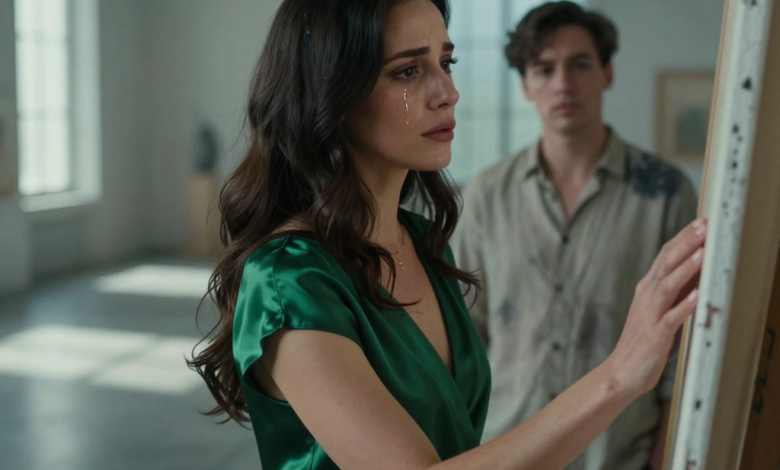
The applause always sounds different when you are living it versus when you are standing outside the theater, listening to its echoes reverberate down lonely hallways. For Elara Vance, whose name alone could launch an entire film trailer into orbit, that difference had become a canyon. Her life—a meticulously curated tapestry woven with red carpets, award nominations, and blinding flashes of paparazzi bulbs—was supposed to be flawless. She was the golden girl, the darling of the industry, the embodiment of effortless Hollywood grace. But behind the perfect veneer, beneath the dazzling smile calibrated for prime-time television, a profound, silent ache had taken root, centered entirely around her younger brother, Silas.
Silas wasn’t meant for the spotlight; he was meant to paint within it. While Elara commanded blockbuster franchises with fiery intensity, Silas preferred the quiet communion of his easel. He possessed the kind of soulful stillness that seemed out of place in a city built on frantic motion. His canvases weren’t just pigments and linen; they were captured breaths—moments of fleeting beauty, melancholic twilight skies, or the fierce, untamed spirit of the local wildlife. Their bond wasn’t one of sibling rivalry, but of complementary orbits: Elara was the supernova, Silas, her grounding nebula.
Their connection was a language spoken in shared glances over studio coffee, whispered late-night anxieties during costume fittings, and the quiet pride Elara felt watching him navigate his own path outside the glittering orbit of ‘Elara Vance.’ He didn’t seek validation by imitating her; he sought authenticity. He chased light in places she only recognized as scenery—dusty antique shops, forgotten botanical gardens, and the rugged coastline just an hour south of the sprawling city where their mansion stood.
“They call me lucky,” Silas would often murmur, his charcoal-smudged fingers pausing mid-stroke, looking at her with eyes that held a depth beyond his twenty-four years. “Lucky to have you as a sister, Elara. But they don’t know the weight of it. Luck is just being near something beautiful. Sometimes beauty hurts.”
Elara would always reach out, tracing the sharp line of his jaw. “Then let it hurt, Si. Let it ache. It means it mattered enough to be felt.”
They had a tradition: every milestone—a successful premiere for her, a gallery showing for him—was met with an almost ritualistic celebration. They’d visit their old neighborhood coffee haunt, The Gilded Bean, and sip dark roast while Silas recounted the technical challenge of his latest piece, or Elara would recount the grueling emotional arc she just pulled off in a dramatic thriller.
Their unspoken understanding was powerful enough to silence crowded rooms. It was the shared history—the scraped knees on suburban sidewalks, the whispered secrets under monsoon skies, the mutual understanding that they were both navigating an industry designed to commodify every single facet of your soul.
The shadow started subtly. First, it was a missed phone call during a grueling shoot in Prague. Then, it was Silas canceling a highly anticipated showing because he felt ‘a creative block’—which Elara knew meant the weight of expectation had become too crushing for his delicate artistic temperament. She would press him gently, but he would pull back, retreating into the protective shell of his studio.
The whispers began filtering in from their inner circle. “He’s withdrawn.” “He seems… brittle.”” Elara felt a cold knot tightening beneath her sternum. Her mother, who understood the delicate ecosystem of creative minds better than anyone, observed it with growing concern.
One evening, after Elara had poured her own anxieties out over dinner—worries about box office returns, casting nightmares, and the relentless public scrutiny—Silas barely tasted his artisanal pasta. He stared past her at the rain streaking down the panoramic window overlooking their manicured grounds.
“It’s the comparison,” he finally whispered, the word sounding heavy, like wet velvet. “You are everything polished, Elara. The triumph, the glamour, the narrative arc that makes people cry on cue. And I… I am just the quiet background piece. The meaningful footnote.”
Elara felt a sting behind her own eyes. She had always been fiercely protective of his quieter brilliance, but hearing him articulate the struggle—it was different. It was vulnerability stripped bare, presented for her singular consumption.
“But you ARE not a footnote,” she insisted, leaning across the table, gripping his hand over the linen tablecloth. “You are the color in the margins! You are the texture they lean into when the main story gets too loud. Your quiet moments? They are richer than most people’s loudest shouts.”
He shook his head slowly, a profound weariness settling onto his features. “No. When I look at your work, Elara, it demands something from me. It demands that I *be* good enough to stand next to it. My latest piece—the one of the storm breaking over the cliffs? It feels desperate. Like I’m trying too hard to match the magnitude of your dramas.”
The pressure was palpable. Elara saw the tension radiating from him, the way his shoulders seemed perpetually braced for an invisible impact. She realized her own success, which she had once viewed as a shield for him, might actually be the cage itself.
Weeks bled into months. The public continued to laud Elara’s meteoric rise in prestige projects. Interviews showcased her profound gratitude for her supportive family life. But behind the polished façade, Elara felt like an actress playing a part where the co-star was fading away from view.
The breaking point arrived on the eve of the Venice Film Festival. Elara was supposed to be radiant, gracious, and subtly melancholic—the perfect blend of triumph and introspection. She dressed in emerald silk that seemed to absorb and amplify the Italian twilight. But when she stepped out onto the Lido boardwalk for the final press junket photos, she saw him.
Silas had managed a rare public appearance, standing near the periphery, clutching his portfolio like a lifeline. He looked gaunt. His usually vibrant brown hair seemed duller under the European sun, and there was a shadow beneath eyes that held too much observation and not enough joy. When their gazes locked across the buzzing crowd—a sea of flashbulbs, designer sunglasses, and manufactured smiles—the connection snapped taut, vibrating with years of unspoken strain.
He didn’t offer her his customary small, wry smile; he offered something more devastating: a flicker of utter exhaustion mixed with profound disappointment. It was a look that said, *You are succeeding, but at what cost to the peace between us?*
Elara felt a sudden, overwhelming surge of emotion—a grief so immediate and absolute it stole her breath mid-breath. It wasn’t mourning yet; it was pre-mourning, the terrifying realization that something precious was slipping away before the final act even began.
Later that night, back in their quiet study, after the frenetic energy of the festival had subsided into a low hum of champagne glasses and hushed congratulations, Elara finally broke the dam. She didn’t speak about her movie; she spoke only of him.
“Silas,” she whispered, sinking onto the antique leather chaise lounge, reaching for his hand again, this time with a desperate clutch. “Stop trying to be the supporting actor in my blockbuster life. Be Silas. Be magnificently, stubbornly *you*. Stop looking at me as if you’re waiting for me to finally notice how fragile you are.”
He looked down at their clasped hands, tracing the faint scar near her knuckle—a memento from a childhood bike accident. His eyes welled up, not with dramatic tears, but with quiet, genuine surrender.
“But what if I *am* just fragile? What if this… this beautiful thing we built together is too much for me to sustain?”, he managed, his voice cracking on the final word. He looked up at her then, a flicker of panic overriding the weariness. “What if the weight of being your brother demands that I shatter?”
Elara felt the tears finally spill over, tracing hot paths through her meticulously applied stage makeup. She leaned forward, resting her forehead against his shoulder, inhaling the familiar scent of turpentine and aged canvas.
“Then let me be there to catch you,” she murmured into his collarbone. “Let me hold the pieces until you decide you’re ready to put them back together.”
That night marked a turning point. Silas didn’t instantly become buoyant; recovery from deep-seated performance anxiety and self-doubt is never linear, it’s cyclical. But he stopped fighting the comparison so fiercely. He started *integrating* it.
He began painting Elara not as a supernova, but as an incandescent force contained within a delicate vessel. His new works featured her caught mid-laugh, her emerald gown catching the light like captured jungle canopy; him painted her in moments of raw vulnerability—tears streaming down her face during a dramatic monologue rehearsal, looking less like a goddess and more like a fiercely beloved human.
And Elara began to change. She started allowing herself unguarded moments on set. Instead of always being the untouchable icon, she would pause for Silas when he visited, letting him frame her in his quiet, discerning gaze. The applause became secondary; the authentic connection was paramount.
The true tragedy, the one that had been simmering beneath the surface for years, finally surfaced during a late-night gallery viewing of Silas’s magnum opus—a piece titled ‘The Weight of Applause.’ It depicted Elara not under a spotlight, but standing alone in a vast, cavernous room, bathed only by moonlight filtering through high arched windows. She wasn’t smiling widely; she was looking away, her expression one of deep, contemplative melancholy.
As the curator introduced it, speaking eloquently about ‘the beautiful burden of expectation,’ Elara felt that familiar ache return, sharper this time because it was externalized, made public.
She looked at the painting. She saw herself—her own struggle rendered perfectly by his hand. And then, in the corner of the canvas, nestled beneath her feet, she spotted a small detail: a solitary, brilliant streak of orange paint, mirroring the color he always associated with joy and vitality. It was him acknowledging her pain, honoring her effort.
As the crowd murmured appreciation, Elara felt an unstoppable force welling up inside her—not sorrow, but incandescent gratitude. She stepped forward, ignoring the breathless hush of the onlookers. Her hands trembled as she reached toward the canvas, drawn to the image of her own burdened self. Silas was standing just behind her, his face a mask of hopeful apprehension. He watched her, waiting for her reaction.
She didn’t speak immediately. She let the weight of the painting settle on her shoulders, absorbing its truth. Then, slowly, deliberately, Elara lifted her hand and touched the painted surface where her own cheek rested against the phantom moonlight. A single, perfect tear escaped, tracing a path down the painted curve of her jaw. But instead of falling into despair, that tear seemed to crystallize on the canvas, catching the light.
She looked up at Silas. His anxious features softened, melting into profound relief. In that moment, surrounded by the adulation and the artifice, Elara Vance didn’t feel like a gilded trophy; she felt like a masterpiece in progress. She smiled—a genuine, unpracticed smile that reached her eyes, crinkling the corners until they mirrored Silas’s own weary tenderness.
Then, she spoke, her voice clear and steady, cutting through the polite murmur of the elite crowd. “He painted this,” Elara announced, gesturing to the painting with a reverence usually reserved for religious icons. “He didn’t paint my success. He painted the space it takes up in me. The exhaustion. The quiet ache.” She paused, letting that sink in, her gaze never leaving Silas.
“And look closely,” she continued, gently tapping the streak of orange on the canvas. “That little spark? That’s him reminding me—no matter how large the spotlight gets—that the most vital color in my entire life is his unwavering presence…”,