A Man Kept Manspreading Into a Womans Plane Seat for Hours When He Returned From the Restroom He Shouted What the Hell Did You Do
I boarded that plane expecting the hardest part of my journey to be traveling without my late husband. At sixty-one, I was flying to meet my first granddaughter, Rose, carrying excitement and grief in equal measure.
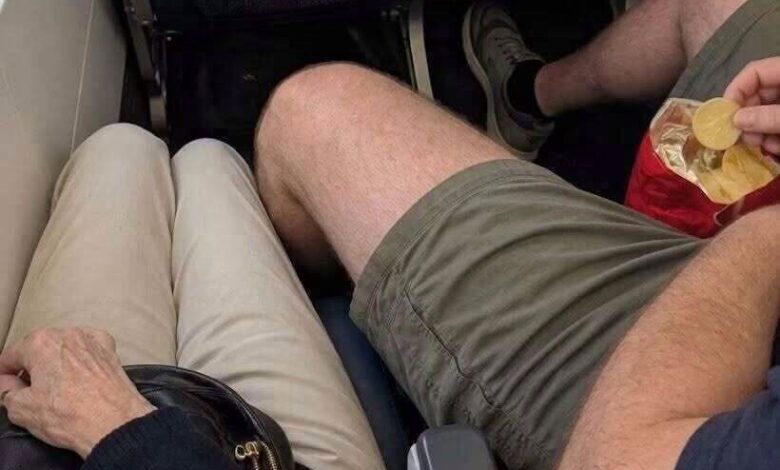
The man beside me, Josh, seemed friendly at first. But twenty minutes after takeoff, he began pushing his knee against mine, stealing the shared armrest, and stretching his legs into my space. Whenever I politely asked him to move, he laughed and blamed his height.
For nearly four hours, I squeezed against the window, my hip aching. When the flight attendant asked if everything was all right, I smiled and said yes. I’d spent my life avoiding confrontation, even when silence meant sacrificing my comfort.
Finally, Josh went to the restroom. I called the flight attendant and explained everything. She offered me an empty aisle seat two rows behind us. I accepted, grateful to stretch my legs without another argument.
When Josh returned, he stared at his empty seat before spotting me behind him. “What the hell did you do?” he demanded. I calmly explained that I’d asked him repeatedly to respect my space. He accused me of exaggerating, but Henry, the gentleman beside us, confirmed he’d witnessed everything.
Later, Josh approached me privately, asking me not to file a complaint because he feared trouble at work. He never asked whether my hip hurt. He only cared about protecting himself. I refused to promise anything and submitted a report after landing.
Then I called my daughter, Marianne. She waited at arrivals with baby Rose. The moment she placed my granddaughter in my arms, my frustration faded. Rose curled her tiny fingers around mine, and tears filled my eyes. I wished my husband, Steven, could have witnessed that beautiful moment.
As Marianne rested her head against my shoulder, I held Rose closer. That exhausting flight taught me something important: kindness doesn’t mean accepting disrespect, and speaking up doesn’t make you difficult. Sometimes, protecting your peace begins when you finally refuse to surrender your place.
What made the journey so frustrating was the contrast between the space she had paid for and the space she was actually allowed to use. The armrest and the boundary between the seats were small things, but the repeated intrusion made it impossible to settle comfortably. She did not board the plane expecting an argument. She wanted the ordinary courtesy that makes a crowded cabin bearable. Each time her discomfort was dismissed, the situation became less about a single movement and more about whether her presence mattered at all. The man's eventual reaction exposed that imbalance. He noticed immediately when something affected him, even though he had treated her discomfort as unimportant for hours. Her response brought the problem into the open without requiring her to surrender the seat she had bought. The moment stayed with her because the lesson was so simple: being considerate in a shared space means recognizing that another passenger's comfort deserves the same respect as one's own.