Can You Find the Four Hidden Objects in This Bed
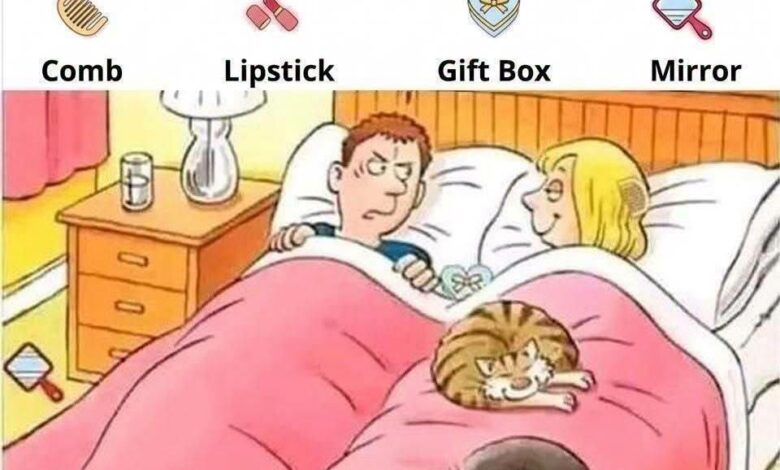
A bedroom illustration challenges viewers to locate four objects hidden among the couple, bedding, furniture, and floor. The missing items are a comb, a small gift box, a mirror, and a tube of lipstick. None is placed where it would normally be expected, and each has been blended into another part of the drawing.
The comb is concealed in the woman’s hair. Its teeth follow the texture of the hairstyle, allowing the outline to look like another group of strands. Instead of searching the bedside table for a grooming item, viewers must notice the repeated straight lines at the back of her head.
The gift box sits between the couple on the bed. Its edges merge with folds, pillows, and the space between their bodies. Because attention is drawn toward faces and the overall scene, the small rectangular shape can be mistaken for part of the bedding.
The mirror is hidden near the floor. Its reflective shape blends into the lower part of the room and may look like an ordinary patch or piece of furniture. Viewers who search only the bed will miss it. Scanning from one corner to another is more effective than repeatedly staring at the center.
The lipstick appears along the lower right side of the comforter near the floor. Its tube-like outline follows the edge and pattern of the blanket. The object is visible, but the brain initially classifies it as decoration because it appears in an impossible place.
Hidden-object puzzles work by exploiting expectation. People know what a comb, mirror, box, and lipstick look like, but they also expect those objects to appear on a dresser or nightstand. When an outline is embedded in hair or fabric, the surrounding scene overrides recognition.
A useful method is to divide the image into sections. Search the people first, then the bed, then the walls and floor. Look for outlines rather than color because the hidden item may share the same shading as its background. Rotating the image or changing viewing distance can also make an artificial edge stand out.
Another technique is to search for the defining feature of each item. A comb needs parallel teeth. A gift box usually has straight sides or a ribbon. A mirror needs a frame or handle, and lipstick has a narrow cylindrical form. Looking for those components is easier than waiting for the complete object to become obvious.
The puzzle is not a scientific test of intelligence. Success depends on screen size, eyesight, familiarity with this style of illustration, and whether someone already knows the trick. A fast solver may recognize the artist’s hiding methods, while a careful observer may take longer and still notice more about the overall scene.
Once the four objects are found, they become difficult to unsee: the comb in the woman’s hair, the gift box between the couple, the mirror on the floor, and the lipstick on the lower right edge of the comforter. The challenge demonstrates how strongly context controls perception. The objects were visible from the beginning; expectation made them disappear.
If you are sharing the puzzle with friends, give everyone the same amount of time and the same image size. Avoid revealing the object locations too early. One useful hint is to say that none of the items is sitting in its normal place. A second hint can identify the general zone—person, bed, or floor—without giving away the outline.
Children can benefit from describing how they found each item rather than only announcing the answer. Asking what line, shape, or pattern revealed the object turns the game into an exercise in visual language. Adults can try the same method and compare search strategies. The most interesting difference is often not who finished first, but which area each person instinctively examined.