My Neighbor Sealed My Driveway with Concrete Because ‘Women Shouldn’t Drive’ – Five Minutes Later, I Wiped the Smile off His Face
At 60, Carol finally earned her driver’s license. Her husband Paul had driven throughout their 41-year marriage, and after his death two years earlier, learning to drive became part of rebuilding her independence. Her best friend Stella celebrated with her at a diner, teasing Carol for obeying every speed limit and signaling even when nobody was behind her.
A new neighbor named Ryan watched Carol’s first drive home without speaking. A few days later, he parked his pickup partly across her driveway while she was preparing for a medical appointment. Carol politely asked him to move. Ryan laughed and told her to take an Uber because women her age had no business driving. She paid for a cab rather than miss the appointment, swallowing her anger.
The harassment continued. Ryan mocked her careful parallel parking in front of teenagers, then all four tires on Carol’s Chevrolet were slashed. She confronted him, but he repeated that driving was a man’s job and ordered her off his porch. Without proof, Carol paid $462 for new tires. She refused to let him frighten her away from the road, though Stella urged her to involve the police.
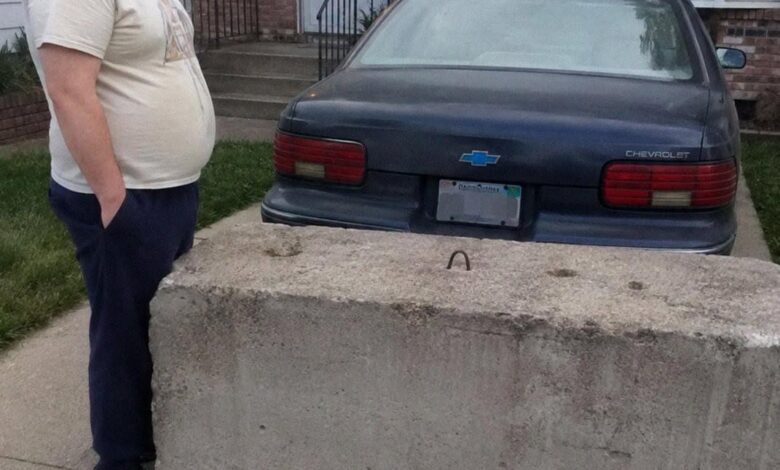
One Monday morning, the sound of machinery woke Carol before seven. Two workers were lowering a concrete block the size of a loveseat directly across her driveway, trapping the Chevrolet. Ryan stood nearby directing them. He claimed the property line ran through the driveway and said a man with a tape measure had confirmed it. Carol knew he had no legitimate survey.
Ryan predicted police would call it a civil dispute and that a lawyer would cost Carol hundreds of dollars. He smirked, told her to use an Uber, and said some people needed to stay in their lane. After the workers left, Carol went inside and allowed herself exactly 90 seconds to cry. Then she remembered a conversation from a neighborhood barbecue several weeks earlier.
At the barbecue, Ryan had boasted that his mother was the reason he had the house and would defend him from anyone who challenged him. His mother, Patricia, had stood behind him looking exhausted by his behavior. Later, she quietly gave Carol her telephone number and said that if Ryan ever crossed a line, Carol should call her directly.
Carol found the number and explained everything: the blocked driveway, insults, slashed tires, and concrete barrier. Patricia’s voice changed immediately. She promised to arrive within five minutes. A silver sedan soon stopped at the curb, and Patricia stepped out carrying a folder while arranging for a contractor to remove the entire block.
When Ryan saw his mother, the color left his face. He ran across the lawn and claimed the concrete had been a joke. Patricia ignored the excuse and informed the workers that her son would pay the removal bill. Then she opened the folder and revealed the fact Ryan had tried to conceal: the house was legally hers, and he was only a tenant.
His lease prohibited harassment of neighbors and unauthorized construction. Patricia handed him written notice that he had 30 days to leave. Ryan begged her to reconsider and turned to Carol, offering to apologize and wash her car every week. Carol finally answered without shaking. She told him the world did not belong to him because he was a man and suggested he try sleeping in an Uber if he needed somewhere to stay.
By 7:45 that morning, the block had been removed and Carol’s driveway was open again. Weeks later, she drove Stella and Patricia to lunch in the old Chevrolet. The three women laughed about Ryan’s expression when he learned that the power he claimed over the neighborhood had never belonged to him.
For Carol, getting a license was about more than operating a car. It represented control over her own time and movement after decades of depending on someone else to drive. Standing up to Ryan taught her another part of independence: handling a problem alone does not mean refusing help. Knowing when to call a trustworthy person can be the decision that puts life back on the right road.